Honest Comparison
Masai Mara vs Serengeti Safari Guide
Kenya vs Tanzania · Migration · Scale · Infrastructure
Two Halves of One Ecosystem
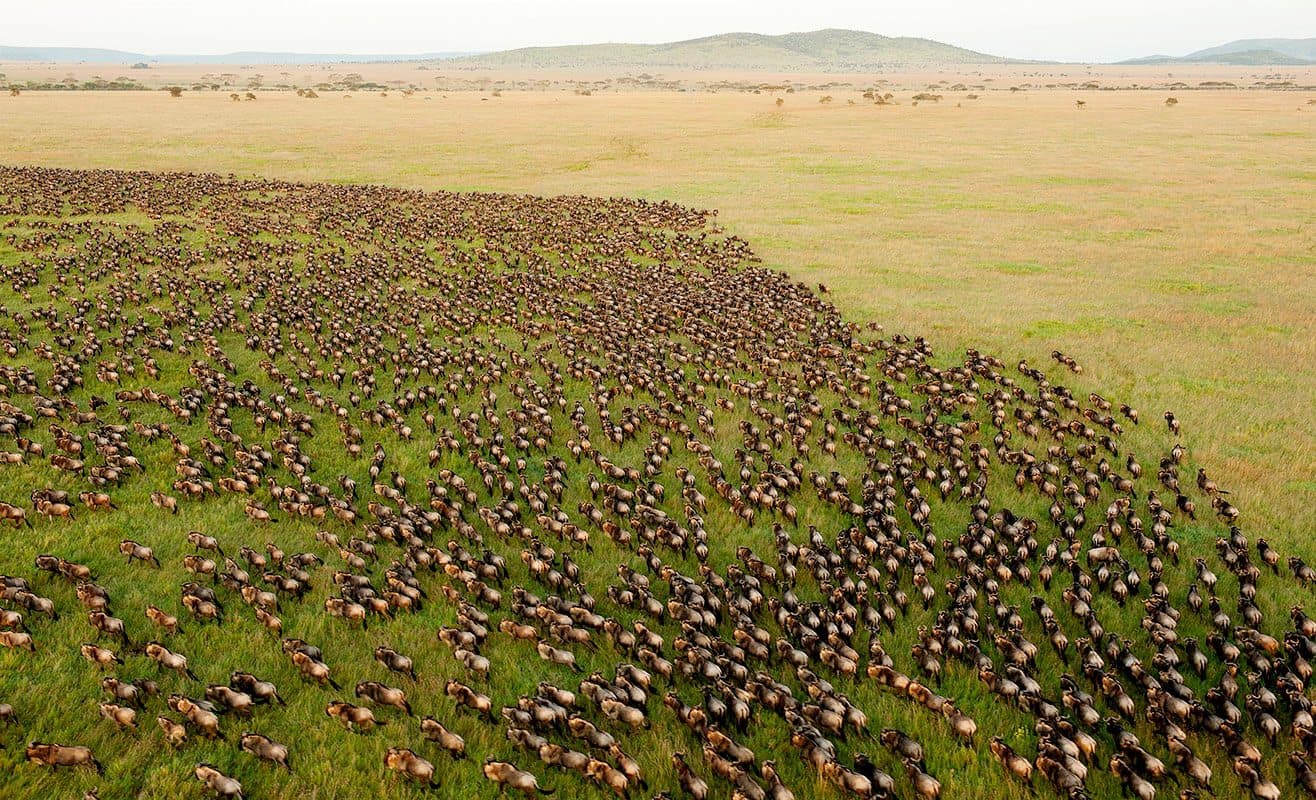
The Masai Mara and the Serengeti are the two halves of the same ecosystem. They share the same wildlife, the same migration, and the same broadly connected landscape. The Mara River in the north connects to Tanzania's plains in the south, and the wildebeest cross the international border twice each year as if it does not exist.
But they are meaningfully different destinations in terms of scale, infrastructure, visitor experience, and what they do best. This comparison is designed to help you decide which to prioritise or whether to combine both in a single Journey.
For seasonal context, see the Masai Mara Great Migration guide and browse sample Masai Mara journeys for itinerary ideas.
Masai Mara vs Serengeti at a Glance
The Serengeti National Park in northern Tanzania covers approximately 14,750 square kilometres, roughly nine times the size of the Masai Mara National Reserve. The wider Serengeti ecosystem extends even further, encompassing the Ngorongoro Conservation Area, the Loliondo Game Control Area, and areas further west.
Narok County's current management plan records the Masai Mara National Reserve at 1,530 square kilometres. Surrounding conservancies protect additional parts of the wider ecosystem, but they should not be reduced to a single fixed total because boundaries and membership change.
This size difference matters for the character of the experience. The Serengeti is vast and less traversable in a short visit. The Mara is more concentrated, which means you cover it more efficiently but also share it with more visitors.
Wildlife
Both ecosystems hold the same cast: lion, leopard, cheetah, elephant, buffalo, wildebeest, zebra, topi, kongoni, Thomson's gazelle, Grant's gazelle, and numerous smaller species. Both lack rhino in meaningful numbers.
Lions: Excellent in both. The Serengeti holds larger overall lion populations due to its size, and the central Seronera area is particularly productive. The Mara's smaller area concentrates sightings. On a standard visit, lion encounters are strong in both.
Cheetah: Slightly stronger in the Mara due to terrain. The open plains provide better visibility and more observable hunting sequences. The Serengeti's cheetah are present but distributed across a larger area.
Leopard: The Serengeti's Seronera River area produces some of the best habituated leopard sightings in Africa, particularly animals that have been photographed and studied for decades. The Mara has leopard but they are less reliably seen.
Elephant: Good in both. Not a primary destination for either.
Wild dog: Rare in both, though Serengeti packs are occasionally seen in the northern and western areas.
Bird diversity: Both are excellent. The Mara has over 450 recorded species; the Serengeti comparable numbers across a broader range of habitats.
Verdict: Very comparable overall, with the Serengeti's Seronera leopard an edge for that specific subject; the Mara's cheetah density an edge for that subject.
The Great Migration
The migration is a shared resource between both destinations. The same herds cross the Tanzania-Kenya border twice each year.
In the Serengeti (January to June):
- ›Calving season (February): southern Serengeti/Ndutu area. An exceptional wildlife event in its own right, rarely visited by first-time Africa travellers.
- ›Western Corridor (May-July): Grumeti River crossings, largely unknown compared to the Mara crossings.
- ›Northern Serengeti/Lamai (July-October): Essentially the same migration phase as the Mara, accessed from the Tanzanian side.
In the Masai Mara (July-October):
- ›The most famous phase of the migration.
- ›Mara River crossings, accessible from both Kenya and the northern Serengeti.
- ›Vehicle congestion at crossings is higher on the Kenyan side than in the Tanzanian Lamai area.
Verdict: The northern Serengeti (Lamai/Kogatende) and the Masai Mara are effectively the same migration window, with the northern Serengeti offering a quieter, less vehicle-crowded experience. The Serengeti also offers calving (February), which the Mara does not. For clients who can only choose one: the Mara is more practical for a short visit; the Serengeti gives a fuller migration calendar if you go twice.
Landscape
The landscapes are different in character and both are compelling.
Masai Mara: Rolling short-grass plains with acacia-dotted escarpments, the Mara River corridor, and the Siria Escarpment in the west. The Mara's scale feels intimate relative to the Serengeti because the horizon does not disappear into distance.
Serengeti: The scale is overwhelming in the most literal sense. The central plains have a vast, almost featureless flatness in certain sections. The kopjes are isolated granite outcrops on the plains and a distinctive Serengeti feature. The Lobo area in the north has a different, more rocky character from the central plains. The southern Ndutu area feels like a different ecosystem entirely, with seasonal lakes, fever tree forests, and open plain.
Verdict: Depends on personal preference. The Mara feels more immediately dramatic due to its topography. The Serengeti's scale is humbling and changes its character as you move through it.
Accessibility
Masai Mara: AirKenya and Safarilink publish multiple daily services from Wilson Airport. Published 2026 timings range from about 30 minutes to the first Mara stop to about one hour, with actual arrival depending on multi-airstrip routing.
Serengeti: Connections via Kilimanjaro International Airport or Arusha, then domestic flights to multiple Serengeti airstrips. Slightly more complex routing. The Serengeti's northern section (Lamai) requires additional flying time from Arusha, which should be considered in shorter itineraries.
Verdict: The Mara is marginally easier to connect to, particularly for international clients arriving via Nairobi. The Serengeti's access improves significantly for clients already in Tanzania.
Accommodation
Both ecosystems have strong accommodation ranges across all tiers.
Masai Mara: The conservancy model creates a significant concentration of small, high-quality tented camps with controlled visitor numbers and full activity programmes. The premium end of the Mara market is well developed.
Serengeti: Larger geographic spread means more accommodation variety across the ecosystem. The Serengeti has extraordinary camps, particularly in the private concession areas of the central Serengeti and in the Lamai area, but also a higher proportion of larger lodge resorts. The northern Serengeti (Lamai/Kogatende) camps are some of the best in all of Africa.
Verdict: Both have excellent options. The Mara's conservancy model provides more consistent quality control. The Serengeti's best camps are as good as anything in Africa.
Cost
Both are premium destinations with comparable price structures at equivalent tiers.
The Serengeti may have a marginal cost edge for cost-conscious travellers using Tanzania's more developed lower-tier lodge network. For premium travellers, costs are essentially comparable when accommodation, park fees, conservancy fees (Mara), and flights are combined.
Tanzania levies higher park fees than Kenya for certain parks; Kenya's Mara conservancy fees can be significant. At the premium level, these differences are not determining factors.
Verdict: Broadly comparable. Full journey cost depends more on accommodation choice and duration than destination.
Trip Length
Masai Mara: Meaningful experience achievable in three to five nights. Manageable within a Kenya-only trip of seven to ten days.
Serengeti: The ecosystem's scale means more time is needed to experience meaningfully different parts of it. A central Serengeti plus northern Serengeti itinerary requires at least five to seven nights across the ecosystem. A Tanzania journey that includes Serengeti, Ngorongoro, and Tarangire works best at ten to fourteen days.
Verdict: The Mara works better for shorter itineraries. The Serengeti rewards longer trips.
Which Is Right for You?
Choose the Masai Mara if:
- ›Your trip is seven to ten days or fewer
- ›You are based out of Nairobi or arriving from a Kenya-focused itinerary
- ›The migration river crossing is your primary motivation
- ›You want a well-established conservancy structure with clear activity options
- ›This is your first Africa journey
Choose the Serengeti if:
- ›You want to see the calving season in February
- ›You want a quieter crossing experience (northern Serengeti)
- ›Your itinerary is based around Tanzania and includes Ngorongoro and Tarangire
- ›You want the scale of the wider Serengeti ecosystem over multiple sections
- ›You want the Serengeti's specific wildlife highlights, such as habituated leopard and Seronera lion prides
Consider both if:
- ›You have ten to fourteen days
- ›The Great Migration in full context is the goal, following the herds across both countries
- ›You want to compare the ecosystems from each side
- ›This is a return Africa visit and you have already done one of the two
Frequently Asked Questions
Is the migration better in the Mara or the Serengeti? They are the same migration, viewed from different sides. In terms of vehicle density, the northern Serengeti (Lamai) tends to be quieter than the Kenyan side. The Masai Mara has better-developed camp infrastructure immediately adjacent to crossing points.
Can I do both on one trip? Yes. A ten-to-fourteen-day Kenya-Tanzania itinerary combining the Mara with the northern Serengeti (or Serengeti plus Ngorongoro plus Tarangire) is one of Africa's most compelling journeys. See Zorani's combined Kenya-Tanzania journey options.
Does it matter which I visit first? Not materially. Either can anchor a combined itinerary. Logistically, routing from Nairobi into the Mara and then connecting to Tanzania works well; so does the reverse from Kilimanjaro.
Related Guides
Zorani Expeditions
Experience the Masai Mara
Every Zorani journey is tailored to the specific client. Let us build the right itinerary around your preferences.
Enquire Now