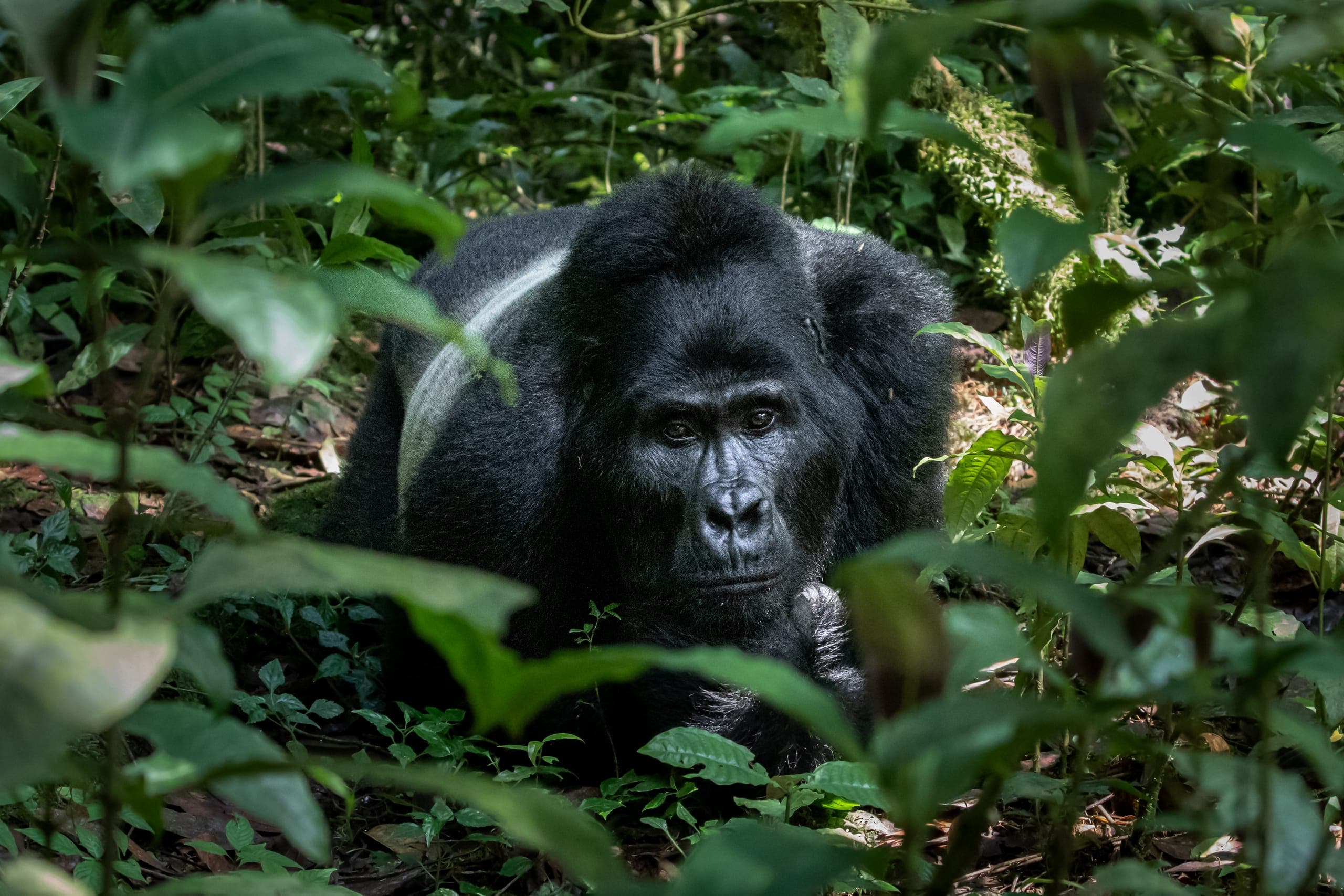
When travellers ask us to choose between gorillas and chimpanzees, we begin with the rhythm of the encounter. Gorilla trekking is usually more visually settled. Chimp trekking is often faster, louder and less predictable.
That distinction is more useful than deciding which primate is more impressive.
A mountain gorilla group tends to remain together and spend considerable time on or near the ground. A chimpanzee community divides into changing subgroups, moves quickly and may feed high in the canopy. One experience rewards close attention to a cohesive social group. The other can feel like following a conversation through the forest.
Neither is universally easier, and neither guarantees a clear view.
The comparison at a glance
Main social pattern: Gorilla trekking involves cohesive family groups, whereas chimp trekking follows fission-fusion communities in changing subgroups.
Typical movement: Gorillas are often slower once located; chimpanzees are frequently faster and more dispersed.
Viewing height: Gorillas are typically at ground level; chimps vary from the ground to the high canopy.
Sound: Gorilla encounters feature grunts and occasional displays; chimp calls can carry over long distances.
Photography: Gorilla shots are steadier but in dense brush; chimp photography is often quick, dark, or backlit.
Physical demand: Gorillas require navigating steep terrain and mud; chimps require pace and repeated repositioning.
Permit cost: Substantially higher for gorillas; lower for chimpanzees.
The table describes tendencies. The behaviour on one day can overturn them.
The social difference shapes the encounter
Mountain gorillas live in relatively cohesive groups. A trekker may see a silverback, adult females, blackbacks, juveniles and infants within one area.
Chimpanzees live in larger communities with a fission-fusion structure. Individuals form temporary subgroups that change through the day. A small party may feed in one tree while other community members remain elsewhere.
This means a gorilla encounter often gives the visitor time to understand spatial relationships. Who rests beside the silverback? Which juvenile initiates play? How does a mother manage an infant?
A chimp encounter can be more fragmented. The visitor may hear several calls, follow a fast-moving male, lose sight of him and then meet a different subgroup farther through the forest.
The experience is not incomplete because the entire chimp community is not visible at once. The separation and reunion are part of chimpanzee social life.
For a closer reading of gorilla behaviour, see Mountain Gorilla Family Life: How Groups Are Structured and What You Are Actually Watching.
What happens on a gorilla trek
The day begins with a briefing and assignment to a habituated gorilla family. Trackers monitor the groups, while the visitor team follows a ranger through the forest towards the family's current location.
The search may be short or take several hours. Once the group is reached and the ranger starts the viewing period, standard trekking allows up to one hour.
During that hour, gorillas may:
Feed
Rest
Groom
Move through dense vegetation
Care for infants
Play
Display
Their larger body size does not make them easier to see in every situation. Thick understorey can conceal all but part of an animal. A settled family may also move soon after visitors arrive.
The complete sequence is covered in Gorilla Trekking in Rwanda: What to Expect on the Day and Bwindi Impenetrable Forest: What to Expect on the Day.
What happens on a chimp trek
Chimp trekking also begins with a briefing and a guided search for a habituated community.
Kibale commonly operates morning and afternoon sessions. Nyungwe usually involves an early start and a search that may last from one to several hours. Zorani builds the lodge, transfer and onward day around the actual session rather than treating “chimp trekking” as one standard timetable.
The first sign may be sound rather than sight. Pant-hoots and other calls help chimpanzees communicate across distance. Guides also read nests, dung, feeding remains and movement in the canopy.
Once found, the chimpanzees may remain in a fruiting tree, descend to the ground or travel quickly. The visitor group may need to reposition several times under the guide's direction.
The maximum standard viewing period is one hour after contact. The practical quality of that hour depends heavily on whether the chimpanzees remain in one place.
Which gives the closer view?
Gorillas often provide a closer and more continuous view. That is a pattern, not a promise.
Mountain gorillas frequently feed and rest near ground level. Their cohesive group structure can keep several individuals in one general area.
Chimpanzees may be:
High in the canopy
Partly obscured by leaves
Silhouetted against the sky
Moving between trees
Split into several parties
On another day, chimps may travel or rest on the ground and offer a sustained view. A gorilla family may remain inside dense vegetation.
No operator controls the final distance, light or behaviour.
Which is more physically demanding?
The answer depends on the site, group location, weather and traveller.
Gorilla trekking is often harder because of terrain
Bwindi and the Virunga volcanoes can involve:
Steep climbs and descents
Mud
Tangled vegetation
High altitude
An uncertain search duration
The pace may be slow, but repeated climbing and difficult footing consume energy.
Chimp trekking is often harder because of pace
Kibale and Nyungwe can involve:
Rapid changes of direction
Stepping over roots and fallen timber
Short, quick climbs
Following calls through dense forest
Repeated movement after contact
The ground may be less steep than a difficult gorilla sector, yet keeping up with travelling chimpanzees can be demanding.
Neither activity should be sold as the easy version of the other.
Discuss fitness, recent injuries and walking pace with Zorani before permits are assigned. The preparation guide is Gorilla Trekking Fitness: What Kind of Physical Condition You Actually Need.
Photography
Gorillas
Gorillas are large and often remain lower in the vegetation. This can provide steadier compositions and better eye-level work.
The difficulties are:
Low forest light
Wet conditions
Dark subjects against bright leaves
Vegetation across the face
Limited space to change position
Chimpanzees
Chimp photography may require faster decisions.
The difficulties are:
Strong backlight in the canopy
Rapid movement
Greater distance
Small gaps between branches
Repeated repositioning
A long lens can help with canopy views, but heavy equipment becomes a burden when the group moves. For either trek, one manageable camera body and a versatile lens are usually more useful than a complex kit.
Flash is not permitted.
Sound and atmosphere
Chimp trekking has the stronger acoustic dimension.
A chimpanzee may be heard before it is seen. Calls can trigger replies elsewhere in the forest and reveal that the visible subgroup is part of a much larger community.
Gorilla encounters are often quieter. Feeding sounds, low vocalisations and vegetation movement become more noticeable because the group is concentrated nearby.
This is not a comparison between excitement and calm. It is a difference in how information travels through each social system.
Cost
Chimp trekking costs materially less than gorilla trekking in both Uganda and Rwanda.
The exact comparison changes with tariff periods, visitor categories and whether park entry is charged separately. Zorani quotes the complete activity cost for the actual travel date rather than relying on one headline permit price.
Uganda low-season chimp trekking rates
Uganda's low-season permits apply in April, May and November. The notice gives discounted rates for foreign non-residents and foreign residents only.
Foreign non-resident: USD 200
Foreign resident: USD 150
Rest of Africa / EAC citizens: No separate low-season rate published
Low-season permits cannot be rescheduled. The notice does not state a separate park-specific low-season rate, so Zorani confirms the activity location and total charge before payment.
Kibale chimp trekking prices from 1 January 2027
Foreign non-resident: USD 300
Foreign resident: USD 200
Rest of Africa citizen: USD 100
East African Community citizen: UGX 180,000
Kyambura Gorge chimp trekking prices from 1 January 2027
Foreign non-resident: USD 200
Foreign resident: USD 150
Rest of Africa citizen: USD 100
East African Community citizen: UGX 50,000
Uganda chimp habituation prices from 1 January 2027
Foreign non-resident: USD 400
Foreign resident: USD 300
Rest of Africa citizen: USD 250
East African Community citizen: UGX 250,000
The low-season notice publishes a discount for standard chimpanzee tracking, not chimpanzee habituation. It does not provide a low-season figure for Rest of Africa or East African Community citizens.
Nyungwe's pricing structure is separate and can combine an activity fee with park entry. We confirm the current Rwanda total for the traveller's date and category before presenting the Journey.
The practical budget should include:
Activity permit
Park entry where charged separately
Accommodation
Transfers
Porter where available
Gratuities
Any required local guide or vehicle
Do not compare one headline permit with another country's complete day cost.
Age and health rules
Age rules are site-specific.
Standard gorilla trekking has a minimum age of 15 in Uganda and Rwanda. Kibale currently uses a minimum age of 16 for chimp trekking. Zorani confirms the Nyungwe minimum before designing a family Journey.
Do not assume that a child permitted on one primate activity qualifies for the other.
Both activities involve close genetic relatives of humans. Travellers with symptoms of infectious illness may be refused participation. Honest illness reporting, mask use where required, distance and ranger instruction protect the animals as well as the visitor.
Read Gorilla Trekking Age Restrictions and Family Travel: What the Minimum Age Rule Means for Your Trip for the family-planning implications.
Uganda: Kibale with Bwindi or Mgahinga
Uganda offers the most natural overland pairing of chimp and gorilla trekking within a longer western circuit. It is a route we use when the traveller wants both primates and safari without turning every day into a transfer.
Kibale sits north of Queen Elizabeth National Park. Bwindi and Mgahinga lie farther southwest. A Journey can therefore progress through:
Kibale for chimp trekking
Queen Elizabeth National Park for safari
Bwindi or Mgahinga for gorillas
This sequence gives the route logic rather than forcing two primate excursions together. It also allows recovery time between forest days.
The compromise is movement. Road transfers take time, and a compressed circuit weakens both activities.
Rwanda: Nyungwe with Volcanoes National Park
Rwanda combines chimp trekking in Nyungwe National Park with gorilla trekking in Volcanoes National Park.
The two parks are in different parts of the country. A strong route allows for the transfer and uses the landscape between them rather than treating it as dead time.
Nyungwe contributes more than chimp trekking. Colobus monkeys, forest walks, birding and canopy-level perspectives can justify a fuller stay. Volcanoes adds gorillas, golden monkeys and the wider Virunga setting.
We run the sequence in either direction. Arrival logistics, accommodation and the rest of the Journey decide it.
Choose gorillas when
Prioritise gorilla trekking when:
One major primate experience must carry the Journey
A more concentrated social encounter matters
Ground-level observation and photography are important
The higher permit cost is acceptable
The traveller can manage uncertain mountain terrain
Bwindi, Mgahinga or Volcanoes fits the wider route
Gorillas are not the automatic choice because they are larger or more expensive. They are the stronger choice when the style of observation suits the traveller.
Choose chimpanzees when
Prioritise chimp trekking when:
Calls, movement and social complexity are the main interest
The traveller accepts canopy views and rapid repositioning
The budget does not support a gorilla permit
Kibale or Nyungwe already belongs in the route
Other forest primates and birdlife matter
A choice between morning and afternoon sessions improves the Journey
Chimp trekking should not be framed as the cheaper substitute. It is a different encounter.
Do both when the route has room
The two activities explain each other.
Gorilla trekking makes cohesion, physical presence and slow observation clear. Chimp trekking shows a larger community communicating and reorganising across the forest.
In Uganda, the pairing works particularly well inside a considered western circuit. In Rwanda, it works when Nyungwe and Volcanoes each receive enough time and the transfer is planned properly.
Do not add both by shortening every other part of the Journey. Two rushed forest days connected by long road movements create a list of permits, not a coherent route.
The decision
We recommend gorillas for a concentrated hour with a cohesive group. We recommend chimpanzees for a more mobile search shaped by calls, canopy movement and changing subgroups.
Choose both when the wider Journey supports the geography and recovery time.
The better experience is the one whose uncertainty the traveller finds interesting. Gorilla visibility can be steadier, but the terrain may be harder. Chimp permits cost less, but the viewing can demand more speed and patience.
For the country decision, read Uganda vs Rwanda Gorilla Trekking. For the complete gorilla planning framework, return to Gorilla Trekking in Uganda and Rwanda: The Complete Planning Guide.