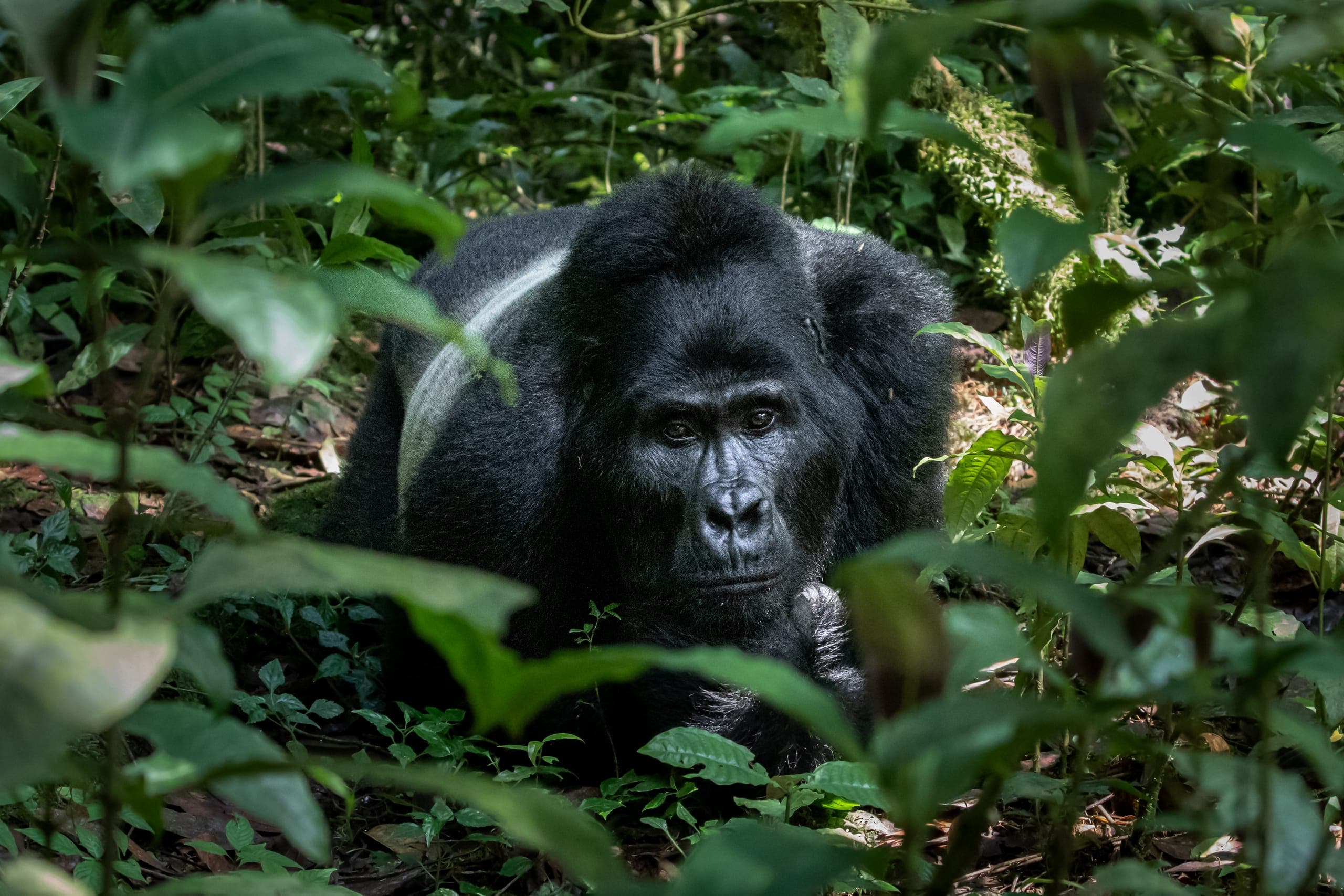
When travellers ask what their Rwanda gorilla permit supports, we give a careful answer: it helps finance a conservation system. It does not buy a single, traceable intervention.
Permit and park revenue support the institutions around Volcanoes National Park. This includes protection, monitoring and park management. Rwanda also directs a stated share of national park revenue to projects in neighbouring communities.
The connection is real, but it should be described carefully. Tourism revenue moves through public systems, conservation partnerships and the wider local economy. Benefits are not distributed evenly, and visitor access also creates risks that must be controlled.
What the gorilla permit pays for
The permit provides access to one managed trek in Volcanoes National Park, subject to the park's rules. It also contributes revenue to the broader conservation and tourism system. That system includes:
Ranger and tracker operations
Daily monitoring of habituated gorilla groups
Law enforcement and snare removal
Park administration
Habitat management
Visitor infrastructure
Conservation partnerships
Community revenue sharing
This is a more accurate explanation than saying that a fixed amount from each permit pays a tracker, a school or a veterinary treatment.
There is no fixed per-permit receipt showing how every dollar is assigned. Park income is collected and managed across programmes. This is why we do not tell a traveller that one permit paid for a named tracker, school or veterinary treatment.
For the current permit rate and inclusions, read Rwanda Gorilla Permit Prices: What USD 1,500 Actually Buys.
Daily protection is labour-intensive
Mountain gorilla conservation depends on people entering the forest every day.
Trackers locate habituated groups, identify individuals and record changes in health, movement and group composition. Protection teams patrol for illegal activity and remove snares. Park managers coordinate access, habitat work and law enforcement.
The operating cost is continuous. It does not end when a census is complete or when no visible threat is reported.
Daily monitoring can reveal:
A missing group member
An injury
A birth
A change in leadership
A snare in the group's range
Unusual respiratory signs
Movement into a higher-risk area
That information allows park staff and conservation partners to respond earlier than they could through occasional surveys alone.
Veterinary care is specialised and selective
Gorilla Doctors provides veterinary monitoring across the mountain gorilla range in partnership with government authorities and conservation organisations.
The animals are not treated as a captive collection. Intervention is considered when a condition is life-threatening or linked to human activity, particularly a snare injury. Field veterinarians also conduct post-mortem examinations and disease surveillance.
This work matters because habituated gorillas are exposed to people through research, protection and tourism. Human respiratory pathogens are a particular concern.
Tourism therefore creates both revenue and risk. The conservation value depends partly on how well illness screening, distance, masks, group limits and the one-hour viewing period are enforced.
Read Gorilla Trekking Rules and Etiquette: The Seven-Metre Rule and What Else Actually Matters before travel.
Rwanda's community revenue-sharing programme
Rwanda's official revenue-sharing policy directs 10 per cent of national park tourism revenue to communities surrounding the country's parks.
This is national park revenue, not a claim that 10 per cent of each individual gorilla permit is handed directly to a village beside Volcanoes National Park.
The official 2024 programme total stated that Rwf 12.86 billion had supported 1,108 projects since 2005, including schools, health centres, housing, dairy projects and other local infrastructure.
The programme matters because communities near a protected area may carry costs that a visitor does not see:
Restricted access to land and forest resources
Crop damage
Wildlife conflict
Pressure on land values and livelihoods
Unequal access to tourism employment
Revenue sharing is intended to make conservation benefits more visible and practical. It is one mechanism, not a complete settlement of those costs.
Wildlife-damage compensation
Rwanda also operates a wildlife-damage compensation system financed through a share of tourism revenue.
Compensation and revenue sharing serve different purposes.
Revenue sharing funds community projects. Compensation responds to specific losses associated with wildlife. Neither guarantees that every household affected by a protected area receives an equal benefit.
The current percentage, eligibility rules, claim process and payment record should be checked before publication if the article gives operational detail. These policies can change and implementation matters as much as the headline allocation.
Jobs and local purchasing
Gorilla tourism supports employment beyond the park authority.
The local economy can include:
Guides, trackers and porters
Lodge staff
Drivers
Farmers and food suppliers
Craftspeople
Construction and maintenance workers
Community tourism enterprises
These effects are important, but should not be overstated. A job in tourism is not distributed to every household. Higher-value roles may require training, language skills, capital or professional networks that are not equally available.
A lodge buying locally can widen the benefit. A lodge importing most supplies or hiring mainly from elsewhere may have a smaller local effect, even when occupancy is high.
Traveller choices therefore matter at the margin. The permit enters the public conservation system. Accommodation, guiding and purchasing choices influence where some of the wider tourism value lands.
Where the model has limits
Independent research broadly supports the value of Rwanda's tourism revenue-sharing policy while identifying weaknesses in how benefits are experienced. These findings matter because a headline percentage does not show who actually participates or benefits.
A 15-year review published in Frontiers in Sustainable Tourism found meaningful investment in community projects, but also reported concerns about participation, awareness, allocation and the measurement of conservation outcomes.
Other studies around Volcanoes National Park have raised related issues:
The poorest households may be less able to enter cooperatives or tourism enterprises.
Political influence can affect which projects are prioritised.
Community members may not see a direct connection between a project and conservation behaviour.
Benefits may be collective while the costs of crop loss are borne by particular households.
Consultation can be weaker than the programme's public description suggests.
This does not make revenue sharing meaningless. It shows why a percentage alone is not enough to judge success.
The important questions are who participates, who decides, who benefits and whether the programme reduces the practical costs of living beside the park.
Conservation depends on more than tourism
Permit revenue is important because mountain gorilla protection is expensive and continuous. It is not the only source of support.
The wider system also involves:
Government budgets and political commitment
International conservation organisations
Research funding
Philanthropy
Veterinary partnerships
Cross-border coordination with Uganda and the Democratic Republic of Congo
Community organisations
Rwanda's tourism model gives the gorillas substantial economic and political visibility. That can strengthen the case for protecting habitat. It can also create dependence on an industry vulnerable to disease outbreaks, travel disruption and economic shocks.
A resilient conservation system needs finance beyond one visitor market.
Tourism is not impact-free
The permit should not be treated as proof that the visit is automatically beneficial.
Tourism can add:
Disease risk
Pressure to habituate more groups
Traffic and construction around the park
Demand for water, energy and land
Uneven growth in property values
Behavioural disturbance if rules are weak
Controlled access reduces these risks. It does not remove them.
The visitor's conduct affects whether the model works as intended. Report illness honestly. Wear the required mask correctly. Follow the ranger's distance instruction. Do not push forward for a photograph or expect the vegetation to be cleared.
The permit is part of the conservation contribution. Compliance is another part.
Does the high permit price help?
Rwanda's high permit price limits the number of visits that can generate a given level of direct permit revenue. It also positions gorilla trekking as a tightly controlled, high-value activity.
That approach can support conservation if:
Visitor numbers remain within defensible limits
Revenue reaches protection and community programmes
Rules are consistently enforced
Local enterprises can enter the tourism economy
The park's ecological condition is protected
Price alone does not guarantee any of these outcomes.
The proper comparison with Uganda is not simply which permit is cheaper. It is how permit availability, route design, park access, accommodation geography and the wider conservation systems fit the traveller.
Read Uganda vs Rwanda Gorilla Trekking for that decision.
What a traveller can responsibly say
A Rwanda gorilla permit helps fund the managed tourism and conservation system around Volcanoes National Park. The national revenue-sharing policy directs a stated share of park revenue to community projects, while park agencies and partners provide monitoring, protection, veterinary care and research.
It is not accurate to claim that one permit pays for a named school, a particular patrol or a fixed number of veterinary interventions.
The strongest contribution is collective. A controlled number of visitors provides substantial revenue and gives the gorillas visible national value. That contribution remains credible only when the rules control tourism's own risks and when neighbouring communities receive meaningful, fairly governed benefit.
For the wider history behind this model, read Dian Fossey and the Story of Mountain Gorilla Conservation. For complete trip planning, return to Gorilla Trekking in Uganda and Rwanda: The Complete Planning Guide.