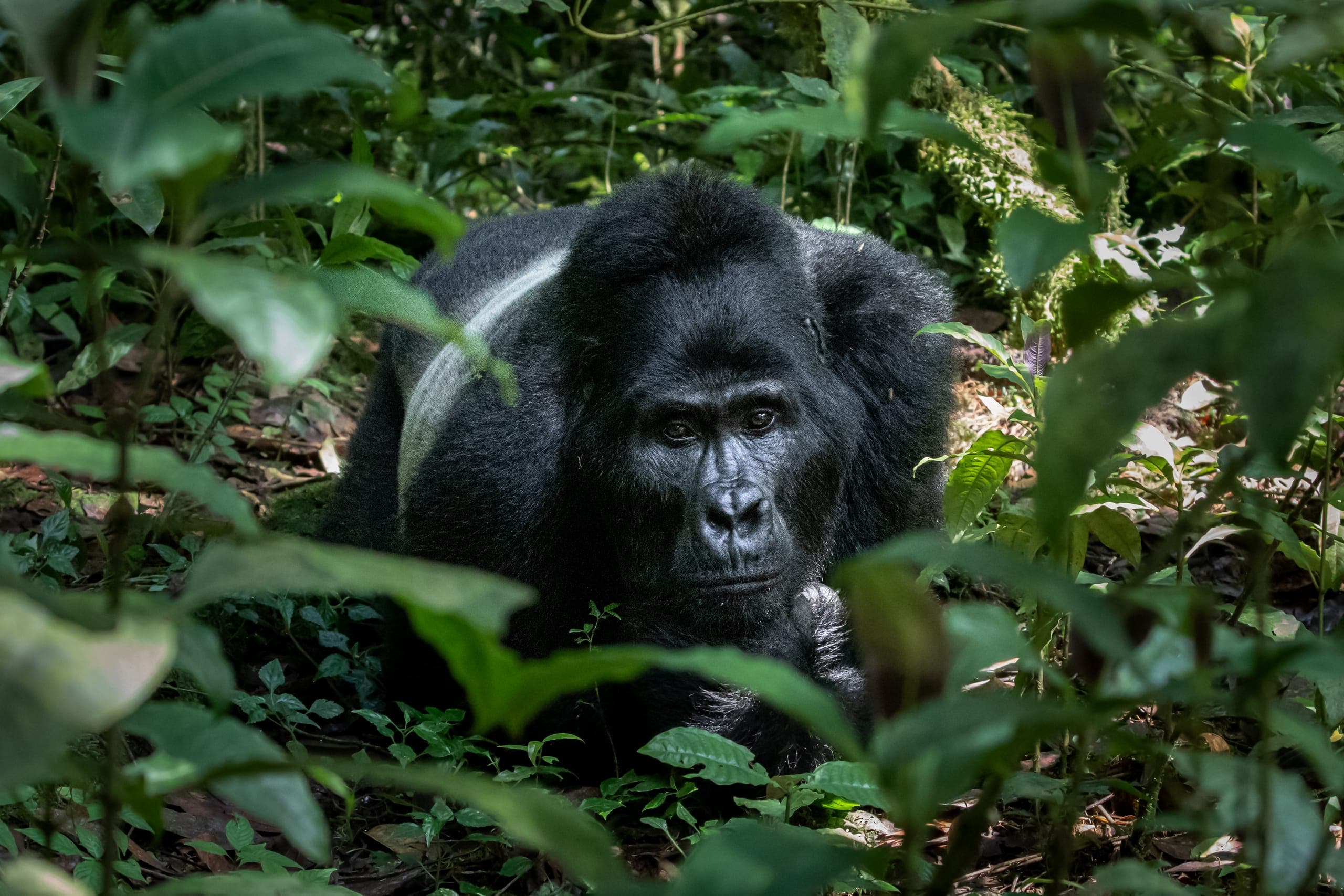
The mountain gorilla's conservation status improved from Critically Endangered to Endangered in 2018.
That was a genuine recovery. It was not a declaration of safety.
Across the treks Zorani operates, much of the protection system is visible in the people around the experience: trackers entering the forest, rangers controlling access, guides enforcing distance and teams recording the condition of known individuals. The population story explains why that daily work cannot be relaxed.
The last published global estimate is 1,063 mountain gorillas across two isolated populations. A newer count in the Bwindi-Sarambwe ecosystem was completed in 2025, but the results were still under analysis in April 2026.
Until those results are published, 1,063 remains a baseline rather than a live headcount.
What the IUCN status change means
The International Union for Conservation of Nature assesses extinction risk through the IUCN Red List.
In 2018, the mountain gorilla subspecies, Gorilla beringei beringei, moved from Critically Endangered to Endangered. The assessment reflected a sustained increase in the known population.
The categories have precise conservation meanings:
Critically Endangered indicates an extremely high risk of extinction in the wild.
Endangered indicates a very high risk of extinction in the wild.
Moving down one category means the assessed risk has reduced. It does not mean the subspecies has recovered to a secure population or that protection can be relaxed.
There is also a taxonomic distinction. The mountain gorilla subspecies is Endangered, while the eastern gorilla species, which also includes Grauer's gorilla, remains Critically Endangered.
Where the 1,063 figure comes from
Mountain gorillas survive in two populations:
The Virunga massif, shared by Rwanda, Uganda and the Democratic Republic of Congo
The Bwindi-Sarambwe ecosystem, shared by Uganda and the Democratic Republic of Congo
Published survey results counted:
604 mountain gorillas in the Virunga massif
459 in the Bwindi-Sarambwe ecosystem
Together they produced the widely cited global estimate of 1,063.
The two counts were not conducted in the same year. They were combined when the later Bwindi-Sarambwe result became available. That is another reason not to present 1,063 as if every animal had been counted on one date.
Why a census takes time
Mountain gorillas live in steep, dense forest. Some groups are habituated and monitored daily. Others avoid routine human contact.
A population survey cannot rely only on the known tourism groups.
Field teams conduct repeated forest sweeps and examine signs including:
Night nests
Dung
Hair
Feeding remains
Trails
Group composition observed in the field
Faecal samples allow genetic analysis. Researchers use DNA to distinguish individuals, identify sex and reduce the risk of counting one gorilla more than once.
Survey teams return to areas and compare nest sites because gorilla groups move. Laboratory analysis and matching take time after fieldwork ends.
The method is more rigorous than adding sightings reported by trackers, but every estimate still has a confidence range and a survey date.
The population change
The IUCN reported an estimate of about 680 mountain gorillas in 2008. By the 2018 assessment, the known total had passed 1,000.
The increase is unusual among great apes. It reflects decades of unusually intensive protection rather than a removal of threats.
Mountain gorillas reproduce slowly:
Females have long intervals between births.
Infants require years of care.
The loss of a breeding adult can affect a group beyond one death.
A disease outbreak can spread through a cohesive social unit.
Recovery therefore cannot be rebuilt quickly after a major decline.
What drove the recovery
No single intervention explains the increase.
Daily monitoring
Habituated groups are followed by trained trackers. Individual recognition allows staff to detect births, disappearances, injuries and unusual behaviour.
Long-term records reveal whether a group is growing and whether an infant survives. They also provide evidence that periodic population surveys cannot supply.
Protection and snare removal
Mountain gorillas are not usually the intended target of wire snares set for other wildlife. They can still be caught and severely injured.
Patrol teams find and remove snares, document illegal activity and maintain a presence across the protected areas. The 2015 to 2016 Virunga survey found more than 380 snares and recorded a gorilla death linked to one, demonstrating that population growth had not removed this threat.
Veterinary response
Field veterinarians monitor habituated groups and may intervene when an injury or illness is life-threatening or caused by people.
This can include treating a severe snare wound. It does not mean routine handling of wild gorillas. Intervention is selective and conducted with the relevant wildlife authority.
Habitat protection
Both populations occupy small, bounded habitats surrounded by some of Africa's highest rural population densities.
Protecting existing forest prevents direct habitat loss. Work to improve ecological connections, manage park edges and reduce conflict is increasingly important as gorilla numbers and human land use both create pressure.
Transboundary cooperation
The gorillas cross political borders without regard to national jurisdiction.
Rwanda, Uganda and the Democratic Republic of Congo coordinate through park authorities and regional conservation partnerships. Shared monitoring, census work and information exchange reduce the weakness of treating one mobile population as three separate national assets.
Community engagement
People living beside the parks experience restrictions and wildlife costs. Revenue sharing, employment, livelihood programmes and conflict mitigation aim to make protection economically and politically durable.
The quality and fairness of these programmes vary. Their importance does not.
Controlled tourism
Gorilla permits create substantial revenue and national economic value. Tourism can support park operations, community programmes and employment.
Tourism also increases human contact. Its contribution depends on controlling disease and disturbance through group limits, illness rules, masks, distance and restricted viewing time.
The recovery is conservation-dependent
Mountain gorillas remain concentrated in two small areas. There is no captive population that could replace a wild loss.
The present numbers depend on continuing:
Forest protection
Daily field presence
Veterinary capacity
Regional cooperation
Community support
Controlled visitor access
Reliable finance
If those systems weaken, the risk can rise again.
“Conservation success” is accurate only when it is understood as an active condition, not a completed project.
Threats that remain
Human disease
Mountain gorillas are closely related to humans and vulnerable to respiratory pathogens. Habituated groups face repeated proximity to trackers, researchers and visitors.
Ill travellers should not trek. A permit does not override the health rule.
Snares and illegal activity
Snares set for other animals can injure gorillas. Political instability and insecurity can also limit patrol coverage and research access.
Habitat pressure
Agriculture and settlement surround much of the remaining habitat. The protected forest cannot expand easily without difficult land and livelihood decisions.
Climate change
Changing temperature and rainfall may alter vegetation, disease patterns and habitat suitability. Mountain gorillas have some capacity to adjust their range within the forest, but the surrounding landscape limits movement.
Small and isolated populations
The two populations do not naturally mix. Isolation limits genetic exchange and makes each ecosystem responsible for retaining its own viable population.
Tourism pressure
Demand can create pressure for more habituated groups, more infrastructure and weaker enforcement. Maintaining limits is harder when the activity is economically valuable.
Why the next Bwindi-Sarambwe result matters
The 2025 survey provides a newer measure of the larger Bwindi-Sarambwe ecosystem.
Uganda's official April 2026 wildlife status report confirmed that census fieldwork was complete and the data were under analysis, with results expected during 2026.
The final result may show an increase, stability or a local decline. Each outcome needs context:
A higher estimate may reflect real growth, improved detection or both.
A stable estimate can still be positive for a small, slow-breeding population.
A decline requires analysis of where losses occurred and which groups were affected.
A new Bwindi-Sarambwe figure will not, by itself, provide a new global total unless paired with a compatible current Virunga estimate.
Publication should therefore cite the survey report, not a press summary, when the number becomes available.
What the recovery does not prove
The status change does not prove that:
Gorilla sightings are guaranteed
Every population is growing at the same rate
Tourism has no ecological cost
Community benefits are evenly distributed
Veterinary intervention can solve every threat
Political conflict no longer matters
The habitat is large enough for indefinite growth
Population recovery and a well-managed visitor encounter are related, but they are not the same claim.
A recovery measured in continued effort
The mountain gorilla moved away from the highest Red List risk category because protection changed the trajectory.
The last published global estimate of 1,063 is worth taking seriously. So are the limits around it. It combines surveys from two ecosystems, it is not a 2026 count and it describes a subspecies still classified as Endangered.
The next census will refine the evidence. It will not change the central lesson: mountain gorilla recovery depends on sustained, intensive work across borders.
For the historical path into long-term monitoring, read Dian Fossey and the Story of Mountain Gorilla Conservation. For how tourism revenue fits the Rwanda system, read Rwanda Conservation: How Gorilla Tourism Funds Protection. For complete planning, return to Gorilla Trekking in Uganda and Rwanda: The Complete Planning Guide.