RWANDA · EAST AFRICA
Nyungwe
The canopy walkway, thirteen primate species, and a forest older than the surrounding mountains
RWANDA · EAST AFRICA
Montane Rainforest and Primates
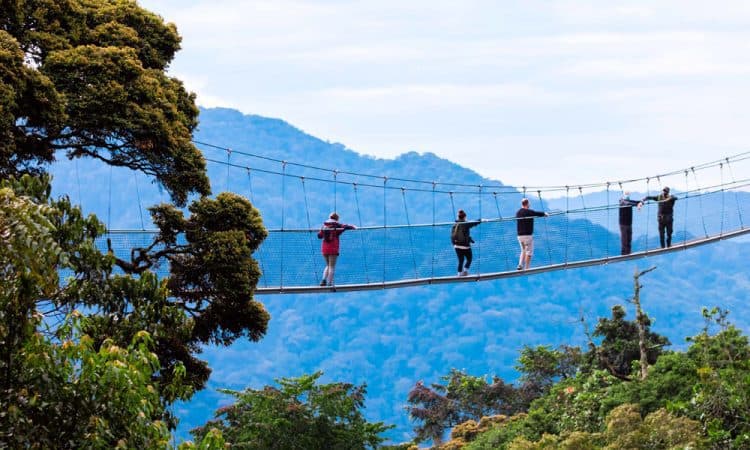
Nyungwe National Park protects one of Africa's largest and most ecologically significant montane rainforests, covering 1,019 square kilometres in southwestern Rwanda. The forest is old in the genuine sense: it has been continuously forested for millions of years, which accounts for its exceptional biodiversity. It holds 13 primate species including habituated chimpanzee and one of Africa's largest populations of Ruwenzori black-and-white colobus. A 90-metre canopy walkway suspended 50 metres above the forest floor provides an aerial perspective of the ecosystem that has no equivalent in the region.
The park sits in the Albertine Rift, a biodiversity hotspot of global significance, and the forest it protects serves as a critical water tower for Rwanda: the Congo-Nile ridge runs through the park and the rivers that flow from it feed both the Congo and Nile systems. The ecological importance of Nyungwe extends well beyond its borders.
For most Rwanda visitors, Nyungwe is the third park in a circuit that begins at Volcanoes in the northwest and moves through Kigali to Akagera in the east before continuing southwest. The forest provides a completely different experience from the other two: no savannah, no volcanic landscape, no gorillas. In their place: a dense, ancient, cool forest, chimpanzees that require skilled tracking, and the canopy walkway as a defining activity.
Safari Experiences
The Case For Nyungwe
Why Visit Nyungwe
The chimpanzee trekking program is the strongest draw. Nyungwe holds a habituated chimpanzee community in a forest that is genuinely wild and large. Unlike some smaller habituated forests, the chimpanzees here range across significant terrain and the trek to find them can be lengthy. The encounter, when it comes, places you with a wild community in a deep forest context rather than a managed corridor or small reserve.
The Ruwenzori colobus troops are the other major primate draw. Nyungwe holds some of the largest colobus groups in Africa, with multi-family troops numbering over 400 individuals. These troops are habituated and regularly encountered on the main trails. The visual experience of a large black-and-white colobus troop moving through the canopy is striking in its own right.
The canopy walkway, at 90 metres in length and suspended 50 metres above the forest floor, provides a perspective on the forest that ground-level trails cannot offer. The walkway connects two large trees in the Uwinka area and the views across the unbroken forest canopy toward the Congo Basin are, on clear days, remarkable. Early morning is the most rewarding time, when the forest is active and mist sometimes sits in the valleys below.
Safaris Through Nyungwe

Terrain & Ecosystem
Landscape & Environment
The Nyungwe forest occupies the Congo-Nile ridge in southwestern Rwanda. Elevation ranges from approximately 1,600m to over 2,950m at the highest points, creating a vertical range across which the vegetation changes significantly. Lower slopes support typical montane forest with large fig and Entandrophragma trees. At higher elevations, bamboo takes over before transitioning to heather and alpine meadow near the ridge.
The terrain is steep throughout. Trails in Nyungwe involve significant elevation gain and loss. The forest receives high rainfall and is wet much of the year. The trail network has been developed over decades and is well established, though slippery conditions are normal after rain.
Several rivers rise in Nyungwe, some flowing west into Lake Kivu and the Congo system, others east toward the Akagera and ultimately the Nile. The watershed position gives the park a hydrological significance that underpins much of Rwanda's water security.
Fauna
Wildlife Highlights
Chimpanzee (Pan troglodytes schweinfurthii) are present in Nyungwe in a habituated research community. The community typically has over 60 individuals and is the largest habituated group in the region. Tracking is more demanding than gorilla trekking because the chimps cover significant ground in a day. Trackers locate the community in the early morning and radio coordinates to the trekking group. The encounter duration is one hour.
Ruwenzori black-and-white colobus are found in very large groups, with assemblages of 50 to 400 individuals regularly encountered on the main trails around Uwinka and Gisakura. The spectacle of a large colobus troop is one of Nyungwe's most reliable and visually powerful encounters.
L'Hoest's monkey is a distinctive, medium-sized monkey with a white bib and dark coat that is common in the forest and often seen from the trail.
Owl-faced monkey (Cercopithecus hamlyni) is an Albertine Rift endemic with a striking facial pattern. Present in Nyungwe but less commonly observed than the colobus or L'Hoest's.
Olive baboon, red-tailed monkey, grey-cheeked mangabey, and Dent's mona monkey round out the 13 primate species. The combined primate diversity is unmatched in Rwanda and one of the highest concentrations in any single forest in Africa.
Birdlife exceeds 322 species, including 29 Albertine Rift endemics. Great blue turaco, Rwenzori turaco, red-throated alethe, and African green broadbill are among the most sought-after. The forest interior, particularly along the Kitabi and Cyamudongo trails, is the most productive zone for Albertine endemics.
Servaline genet and African golden cat are present but rarely observed.
On the Ground
Safari Experiences
Chimpanzee trekking is the primary activity and requires a permit from the Rwanda Development Board (permit cost significantly below gorilla permits; confirm current pricing with your operator). Groups are limited to 8 per community per day. The trek duration is variable, ranging from 1 to 5 hours depending on where the community is ranging. Once found, one hour is spent with the chimpanzees.
Colobus monkey habituation experience: A longer, multi-hour experience with the habituated colobus troops for travelers who want extended observation time beyond what the standard trail walk provides.
Canopy walkway: The 90-metre suspended walkway in the Uwinka area is the most visited non-primate activity in the park. It is accessible as a walk from the Uwinka Visitor Centre. Mornings are best. The walkway closes during high winds.
Guided forest trails: A network of established trails covers different parts of the forest and different primate and bird habitats. The Kamiranzovu Wetland Trail passes through a rare highland swamp with different bird and plant species.
Birding walks: Specialist birding guides can be arranged through your lodge for focused sessions on Albertine Rift endemics. Early morning departures are essential.
Night walks: Available in the forest with a ranger. Productive for African wood owl, pottos, and nocturnal insects and reptiles.
Regions of the Park
Uwinka (Central): The main visitor centre, canopy walkway, and primary trail network. The most accessible section of the park and the base for most colobus encounters.
Gisakura (South): The southern entrance and accommodation zone. The One&Only Nyungwe House is here. Good for chimpanzee access and the Bigugu trail network.
Kamiranzovu (Central): A highland swamp accessible from the main trail network. Productive for swamp-specific bird species and the distinctive highland vegetation.
Cyamudongo: A detached forest block west of the main park, now reconnected by a green corridor. Holds chimpanzee and good birding.
Planning Your Visit
Best Time to Visit
June to September is the dry season and the recommended period. Trails are drier and more manageable, cloud cover is lower (better for canopy walkway views and photography), and chimpanzee tracking conditions are at their most consistent.
December to February is the short dry season and an equally good window. Slightly greener after the short rains.
March to May (long rains): Trails are very muddy and slippery. The forest is at its wettest. Chimpanzee tracking is physically more demanding. Not recommended for casual visitors. Birding can be excellent due to high forest activity.
Getting There
By road from Kigali: The drive from Kigali to the Gisakura entrance (south) takes approximately 5 to 6 hours via Butare (Huye) and Nyamagabe. The road is paved for most of the journey. The final section through the tea plantations is scenic. A 4WD is recommended for the park interior tracks.
From Cyangugu/Rusizi (west): The town on Lake Kivu is approximately 2 hours from the park's western boundary. Some travelers approach via Lake Kivu on a drive from Gisenyi (Rubavu) in the north, combining the lake scenery with the forest.
By charter: There is no commercial airstrip directly serving Nyungwe. Kigali remains the practical entry point.
How Many Nights
2 nights allows for one chimpanzee trek, the canopy walkway, and one guided forest trail walk. Adequate for the core experience.
3 nights adds a second primate activity (colobus habituated experience), dedicated birding, the wetland trail, and a night walk. The recommended minimum for travelers who want to genuinely understand what the forest offers.
Where to Stay
Luxury Lodges and Camps
One&Only Nyungwe House: The benchmark luxury property in Nyungwe, positioned at the forest edge near Gisakura on the site of a tea estate. Individual rooms are designed into the hillside with views across the tea and into the forest. The quality of food, guiding, and service is the highest available in the park area and is consistently regarded as the best Rwanda experience outside of the premium Volcanoes lodges.
Midrange Lodges and Camps
Nyungwe Top View Hill Hotel: A mid-tier option with a good location near the Uwinka area. More basic than One&Only but functional and accessible. Suitable for travelers who want solid access to the park activities without luxury pricing.
Zorani uses its current Luxury and Midrange accommodation tiers in Nyungwe. Selection should account for the trekking sector, transfer time, room standard, and current operating status.
Combining With Other Destinations
Volcanoes National Park is the most natural Rwanda pairing. A Rwanda circuit beginning at Volcanoes in the northwest, moving through Kigali, then spending 2 to 3 nights at Akagera before driving southwest to Nyungwe creates a comprehensive 8 to 10 night Rwanda program covering all three major ecosystems.
Lake Kivu: The western shore of Lake Kivu is 2 to 3 hours from Nyungwe's western boundary. Some travelers combine a Nyungwe stay with 1 to 2 nights at a Lake Kivu lodge (Rubavu/Gisenyi or Kibuye) as a relaxed lake extension before flying home from Kigali.
Uganda's Kibale National Park: Kibale and Nyungwe are both chimpanzee-focused forest destinations with different characters. Kibale is easier to reach, has higher encounter rates, and different species composition. A combined Uganda-Rwanda circuit that includes chimp trekking in both forests is distinctive but logistically complex.
Photography
The canopy walkway on a clear morning, when mist sits in the valley below and the forest extends to the horizon, is the most visually powerful landscape shot available in Rwanda. Wide-angle is the appropriate tool; the walkway itself and the unbroken canopy create a frame that benefits from a full 24mm perspective or wider.
Chimpanzee photography in Nyungwe is more challenging than gorilla photography. The chimps move quickly, the forest is darker, and encounters in the canopy require fast focusing and high ISO performance. A 70-200mm f/2.8 covers most situations but the ability to track moving subjects matters more than reach.
Ruwenzori colobus in large groups on open branches provide some of the most photogenic primate encounters in Africa. The black-and-white contrast is strong and the groups are large enough that compositions do not rely on a single animal.
Albertine Rift endemic bird photography requires a dedicated session with a specialist guide who knows call sites and perch preferences. Early morning in the Cyamudongo or Kitabi areas is the most productive. A 500mm prime or 100-500mm zoom is appropriate.
Nyungwe Questions
What is the Nyungwe canopy walkway?
The canopy walkway is a 160-metre suspension bridge suspended roughly 50 metres above the forest floor in the Uwinka area of Nyungwe. It is the only canopy walkway in Rwanda and one of the longest in East Africa. The walk is done with a guide on a circuit that includes forest trails below and the bridge crossing at the highest point. It is accessible to most fitness levels and does not require a permit beyond the standard park entry fee. The elevated perspective offers views across the forest canopy and, on clear days, across the Congo Basin to the west.
How does chimpanzee trekking work at Nyungwe?
Nyungwe holds one of the largest chimpanzee communities in East Africa, with the main habituated group based in the Cyamudongo forest sector. Tracking begins at dawn and typically takes two to five hours depending on chimp location. You are allowed one hour with the chimps once found. Permits should be booked in advance through Rwanda Development Board. The forest terrain is steep in places, and a reasonable level of fitness is required. Sighting success with the habituated group is generally high: most tracked visits find the chimps.
How much do chimpanzee trekking permits cost at Nyungwe?
Chimpanzee trekking permits at Nyungwe are currently USD 150 per person, significantly less than the gorilla permit cost at Volcanoes. Group sizes are capped to protect the chimps. Permits can be booked directly through the Rwanda Development Board website or arranged through a safari operator. Peak-season availability fills ahead of time, so booking several weeks in advance is advisable for popular travel months.
How many primate species are in Nyungwe?
Thirteen confirmed primate species inhabit Nyungwe: the highest diversity of any single park in East Africa. Beyond chimpanzees, the forest holds Angolan colobus monkey (in troops of up to 400 individuals, which is exceptional), L'Hoest's monkey, grey-cheeked mangabey, olive baboon, vervet monkey, blue monkey, red-tailed monkey, and several others including the rarely seen owl-faced monkey. The colobus troops in Nyungwe are among the largest in the world.
Can I combine Nyungwe with gorilla trekking at Volcanoes?
Yes, and this is the standard full-Rwanda circuit. Volcanoes National Park is in the northwest and Nyungwe is in the southwest: they are roughly four to five hours apart by road via Kigali or via the scenic Route des Crêtes. A combined itinerary typically allocates three to four nights at Volcanoes for gorilla trekking and then transfers south for two to three nights at Nyungwe. Akagera in the east can be added for the full Rwanda triangle covering forest, savannah, and mountain.
Can I combine Nyungwe with Akagera National Park?
Yes. Akagera and Nyungwe represent Rwanda's savannah and forest extremes respectively, and combining them provides genuine habitat and wildlife contrast. The drive from Nyungwe to Akagera via Kigali takes most of a day, so most itineraries overnight in Kigali between the two parks. The three-park Rwanda circuit (Volcanoes, Nyungwe, Akagera) covers the country's full wildlife range in seven to ten days.
What is the best time to visit Nyungwe?
The dry seasons from June to August and December to February are best for trekking. Trails dry out, forest visibility improves, and chimpanzee tracking is more comfortable. The long rains of March and April make trails very muddy and some sections difficult. The forest is green year-round and receives high rainfall even in the dry season due to its altitude and its position on the Congo-Nile divide, so waterproof footwear and a rain jacket are always advisable.
How do I get to Nyungwe?
Nyungwe is approximately five to six hours by road from Kigali via Butare (Huye) in the south. The road is mostly tarmac and the drive through Rwanda's southern hills is scenic. Scheduled charter flights from Kigali to Kamembe Airport near Cyangugu serve the park and reduce travel time significantly: the flight takes approximately 45 minutes. Most premium operators arrange either fly-in access or private vehicle transfers with en route stops at tea plantation landscapes.
How long should I spend at Nyungwe?
Two nights is the minimum for a meaningful visit that includes the canopy walkway and a chimpanzee tracking attempt. Three nights adds a second tracking opportunity and time for additional primate walks to see colobus troops, bird walks, and the Isumo waterfall trail. Four nights suits travellers with a serious interest in birds: Nyungwe holds over 300 species including 29 Albertine Rift endemics.
Is Nyungwe good for birds?
Nyungwe is one of East Africa's premier birding destinations. The park holds over 300 species with 29 Albertine Rift endemics including Rwenzori turaco, strange weaver, Kivu ground thrush, and red-collared mountain babbler. The forest birdwatching is best in the early morning and combines naturally with primate walks. A specialist birding guide is recommended for the endemic-focused list, as several species require knowledge of specific forest zones.
Zorani Expeditions
Plan Your Nyungwe Safari
Every Journey we design is built around your goals, not a standard route.
Speak to a Specialist