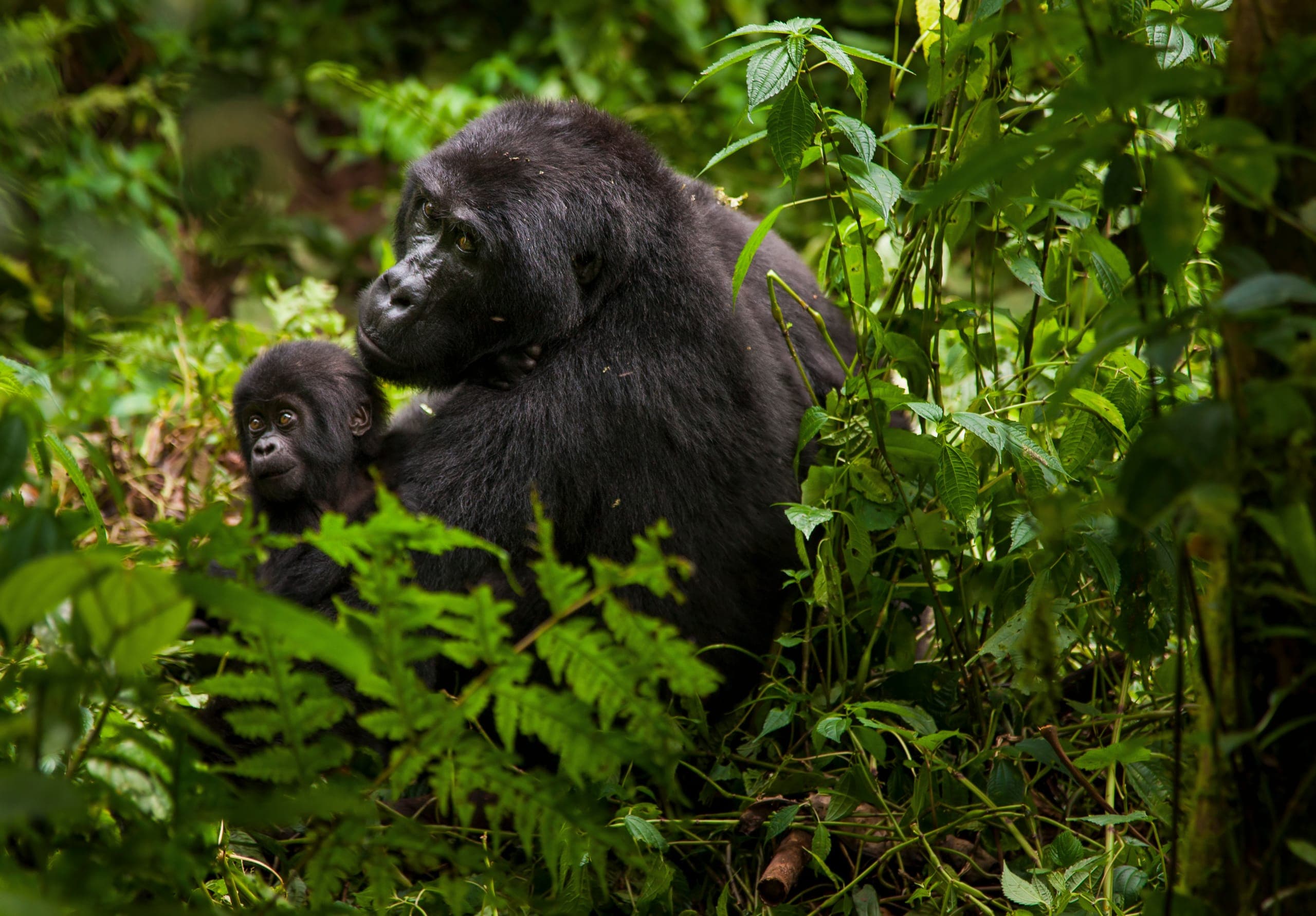
We choose Mgahinga when the traveller wants the Virunga landscape, a smaller gorilla operation and a route built naturally around Kisoro. We do not use it merely because Bwindi permits are difficult to find.
It is not simply “Bwindi without the crowds”. The park has different terrain, far less gorilla-permit capacity, fewer accommodation choices and a stronger mix of golden monkey tracking and volcano hiking.
For the right Journey, those differences are the reason to choose it.
What makes Mgahinga different
Mgahinga protects 33.7 square kilometres on Uganda's side of the Virunga massif. It adjoins Volcanoes National Park in Rwanda and Virunga National Park in the Democratic Republic of the Congo, forming part of one transboundary mountain ecosystem.
Three volcanoes shape the park:
Muhavura
Gahinga
Sabyinyo
The landscape rises through forest and bamboo towards heath and high mountain vegetation. This is different from Bwindi's older, folded forest terrain.
Mountain gorillas remain the principal draw, but Mgahinga also supports golden monkeys, specialist birding, guided forest walks and demanding volcano climbs. A stay can therefore be planned around the park rather than around one permit morning.
Why it feels quieter
Mgahinga's gorilla operation is built around roughly eight visitor permits a day. Bwindi operates across four sectors and many habituated families.
That difference means:
Far fewer gorilla trekkers report at Mgahinga.
The visitor operation is concentrated at Ntebeko.
Permit availability is much more limited.
There is less lodge and transport redundancy when plans change.
Quieter does not mean private. The standard gorilla group can still contain up to eight visitors.
It also does not mean better viewing. The same gorilla rules apply, the family remains wild and the length of the walk is variable.
Gorilla trekking from Ntebeko
Ntebeko Visitor Centre is the reporting point for Mgahinga's principal park activities, including gorilla and golden monkey tracking, nature walks and volcano climbs.
We plan for an 08:00 start and prepare travellers for a variable forest day. Three to five hours is a useful orientation, not a promise. The gorillas' location decides the walking time.
The day includes:
Permit validation
A ranger briefing
Porter arrangements
A guided search using tracker information
A maximum of one hour with the allocated habituated family
The return to the trailhead
The official minimum trekking age is 15. The standard visitor group is capped at eight.
Is Mgahinga easier than Bwindi?
Not reliably.
Mgahinga's gorilla range may produce a more open bamboo setting than parts of Bwindi, and some trekking days may be shorter. The park also begins at elevation and rises on volcanic slopes.
Difficulty depends on:
The gorillas' location
Gradient
Mud and rain
The route used that morning
The traveller's response to altitude
Do not select Mgahinga on a promise of an easy trek. Choose it for route position and park character, then prepare for several hours of sustained walking.
Read Gorilla Trekking Fitness: What Kind of Physical Condition You Actually Need.
Permit capacity is the main compromise
Bwindi provides more options because permits are spread across four sectors and many families. Mgahinga's smaller operation has much less capacity.
This affects:
Date flexibility
Group planning
The ability to replace a permit
Choice during peak periods
The case for booking early
A traveller with fixed dates should not assume Mgahinga can be added after flights and lodges are confirmed. Check the permit first.
A standard Uganda gorilla permit uses the same visitor-category structure in Mgahinga and Bwindi, but it must be issued for the correct park and date. Zorani checks that detail before placing the lodge or other activities.
See Uganda Gorilla Permit Prices: What USD 800 Actually Buys.
Golden monkey tracking
Golden monkeys give Mgahinga a second primate experience with its own character.
They live in the Virunga bamboo zone and move differently from gorillas. The group can be active, vocal and higher in the vegetation, making photography and observation less settled.
Standard golden monkey tracking allows up to one hour once the group is reached. A separate golden monkey habituation activity provides a different, longer field experience.
The two experiences should not be placed on the same day. Gorilla trekking has an uncertain finish, and golden monkeys deserve an unhurried morning of their own.
For a traveller staying three nights, a useful structure is:
Arrive near Mgahinga.
Trek gorillas.
Track golden monkeys or take a separate guided activity.
Leave the following morning.
Zorani confirms golden monkey availability, minimum ages and current prices for the travel date.
Volcano climbing
Mgahinga's three volcanic peaks turn the park into a serious hiking destination.
Mount Gahinga
Mount Gahinga reaches 3,474 metres. Its bamboo-covered slopes rise towards a swamp-filled crater. It is often considered the most manageable of the three climbs, but it remains a high-elevation full activity.
Mount Sabyinyo
Sabyinyo reaches 3,669 metres. The route includes steep ridges, ladders and exposed sections. It suits fit, confident hikers rather than visitors looking for a gentle extension to a gorilla trek.
Mount Muhavura
Muhavura is the highest of the three at 4,127 metres. The trail passes through several vegetation zones to a small crater lake at the summit.
None of these climbs should be scheduled as a recovery day by default. Each needs its own guide, permit, equipment check and assessment of weather and fitness.
Zorani confirms current trail status and border-area operating conditions before including a summit day.
Birding and shorter walks
Mgahinga's forest, bamboo and high-elevation habitats support Albertine Rift specialities.
The principal birding areas include:
Sabyinyo Gorge
The saddle between Gahinga and Sabyinyo
The Boundary Trail around Ntebeko
The Rwenzori turaco as a notable target
Birding needs time. A specialist outing should not be treated as something to fit into the uncertain afternoon after gorilla trekking.
Shorter walks around Ntebeko may suit a traveller who wants the volcanic setting without a summit day. We match the trail to the traveller's fitness and the current access conditions.
Batwa experiences require careful selection
The Batwa Trail interprets how Batwa communities historically used the forest, including the Garama Cave.
The subject requires more than a generic cultural stop. The Batwa were displaced from protected forests and have faced lasting social and economic consequences. A responsible visit should be transparent about:
Who owns and runs the activity
How guides and performers are paid
What community benefit is created
Whether the interpretation presents history honestly
How consent and photography are handled
Zorani assesses the actual provider, guide structure, consent and community benefit before including a cultural activity. A recognised title alone is not enough.
Do not include a Batwa activity because it fills an afternoon. Include it when the provider, structure and traveller interest justify it.
Where to stay
Accommodation is available around Ntebeko, Kisoro and Lake Mutanda. These are not the same base.
Near Ntebeko
This gives the cleanest access to the park headquarters and protects an early start. Choice is limited compared with Bwindi.
Kisoro
Kisoro offers a broader practical base and access to the airstrip, shops and road connections. The drive to Ntebeko still needs to be allowed for.
Lake Mutanda
Lake Mutanda can add a slower setting and wider views of the Virungas. The actual lodge-to-Ntebeko transfer must be checked rather than inferred from the phrase “near Mgahinga”.
The lodge decision should follow the permit and park programme. A property chosen for lake views may be less useful for three consecutive early park starts.
How to reach Mgahinga
Mgahinga is approached through Kisoro.
The wider Journey may:
Arrive by road through Uganda
Use a scheduled or charter flight to Kisoro
Cross from Rwanda through an appropriate border route
Continue between Mgahinga and southern Bwindi
Scheduled and charter flights can connect Entebbe with Kisoro, followed by a road transfer to Ntebeko. We confirm the live schedule, baggage allowance, aircraft operation and final road time for each Journey.
For a route crossing an international border, check immigration requirements, vehicle permissions and opening conditions close to travel. A map estimate does not account for formalities.
Mgahinga versus Bwindi
Gorilla operation
Mgahinga: Small, concentrated at Ntebeko
Bwindi: Spread across four sectors
Permit flexibility
Mgahinga: Limited
Bwindi: Greater overall capacity
Landscape
Mgahinga: Virunga volcanoes, bamboo and high mountain zones
Bwindi: Montane forest across ridges and valleys
Other principal activities
Mgahinga: Golden monkeys and volcano climbs
Bwindi: Forest walks, birding and Uganda's Gorilla Habituation Experience
Accommodation
Mgahinga: Smaller field around Ntebeko, Kisoro and Lake Mutanda
Bwindi: Much broader choice across four sectors
Best route fit
Mgahinga: Kisoro, Rwanda connection and a Virunga-focused stay
Bwindi: Wider Uganda safari routes and greater permit flexibility
Bwindi is usually the safer default for a first Uganda gorilla Journey because it provides more dates, sectors and lodge options.
Mgahinga is stronger when:
The route already uses Kisoro.
The traveller values the volcanic ecosystem.
Golden monkeys deserve a separate day.
A small park operation is preferred.
A multi-day hiking programme is part of the Journey.
How many nights?
Two nights are the minimum for one gorilla trek.
Three nights are better when adding golden monkeys, birding or a relaxed Lake Mutanda stay. Four or more may be needed for a volcano climb because the hike should have its own full day and recovery space.
Do not place gorilla trekking and a summit hike on consecutive days without considering the traveller's fitness and the wider route.
Who may prefer Bwindi
Choose Bwindi instead when:
Dates are fixed and permit flexibility matters.
A broad lodge choice is important.
The Journey comes from Queen Elizabeth National Park or Kihihi.
Uganda's Gorilla Habituation Experience is the priority.
The traveller wants the most established first-time gorilla base.
The sector guide explains the internal Bwindi decision: Bwindi's Four Trekking Sectors Explained: Buhoma, Ruhija, Rushaga and Nkuringo.
The right reason to choose Mgahinga
Mgahinga is not valuable because it is a secret version of Bwindi.
It is valuable because the gorilla trek sits inside a compact Virunga park with bamboo, golden monkeys and three volcanic peaks. The compromise is capacity and lodge choice.
We secure the permit, place the traveller within sensible reach of Ntebeko and give the park more than one functional night. The quieter character then becomes a consequence of good route design, not a marketing promise.
For the wider country and park sequence, read Gorilla Trekking in Uganda and Rwanda: The Complete Planning Guide.


