KENYA · EAST AFRICA
Samburu
Reticulated giraffe, Grevy's zebra, and the dry-country species found nowhere else in Kenya
KENYA · EAST AFRICA
Northern Kenya's Special Five
Samburu National Reserve occupies 165 square kilometres of semi-arid northern Kenya, on the edge of the country's dry interior. It is a smaller reserve than most Kenyan parks, but its ecological distinctiveness makes it one of the most compelling destinations in the region. The wildlife here is fundamentally different from the savannah parks of the south and west: a suite of dry-country species found primarily north of the equator and nowhere else in Kenya.
The Ewaso Ng'iro River runs along the reserve's southern boundary, providing the permanent water that anchors wildlife activity. The riverine woodland fringing the river contrasts sharply with the arid Acacia-commiphora scrub of the interior. Buffalo Springs National Reserve lies directly across the river to the south, and Shaba National Reserve sits further east; all three are typically visited as part of the same broader ecosystem but Samburu itself is the most visited and most productive.
The Samburu people, a Nilotic pastoralist community related to the Maasai, inhabit the land surrounding the reserve. Their presence, culture, and relationship with the landscape are part of what gives the Samburu region its distinct character.
Safari Experiences
The Case For Samburu
Why Visit Samburu
The five species collectively called the Samburu Special Five are the primary draw. Reticulated giraffe, Grevy's zebra, gerenuk, Beisa oryx, and Somali ostrich are all dry-country specialists distributed across the arid lands north of the equator. None of them occur in the Masai Mara, Amboseli, or Tsavo in the forms found here. For travelers who want a substantively different wildlife list from the southern Kenya parks, Samburu is the destination.
The reserve also holds one of Kenya's most visible and well-habituated leopard populations. Sightings rates are high by any comparison, driven partly by the open riverine vegetation and partly by the leopards' familiarity with vehicles. The Ewaso Ng'iro River corridor makes for productive morning drives regardless of season.
The northern Kenya landscape itself is distinctive. The Samburu and Buffalo Springs reserves sit in a wide valley bounded by rocky hills, the Matthews Range visible to the north. The feel is drier, wilder, and less polished than the Mara or Amboseli circuits. Visitor numbers are lower, the atmosphere is different, and the overall quality of a good day in the field here is high.
Safaris Through Samburu

Terrain & Ecosystem
Landscape & Environment
The reserve occupies the valley of the Ewaso Ng'iro River, a permanent river that flows eastward from the Aberdare Mountains and is the primary water source for a vast area of northern Kenya. The riverine woodland along the banks consists of doum palm, riverine acacia, Salvadora, and dense shrub, which provides shade, food, and cover for a wide range of species.
Away from the river, the terrain is open Acacia-commiphora scrubland on sandy and rocky soils. The vegetation is low, thorny, and sparse. Doum palms appear along seasonal drainage lines. The rocky Koitogor Inselberg in the reserve interior provides a landscape feature and leopard habitat.
Temperatures in Samburu are consistently high throughout the year. The reserve sits at approximately 900 metres and the equatorial position means the climate is warm year-round. Early morning drives are essential both for wildlife activity and for comfort.
Fauna
Wildlife Highlights
Reticulated giraffe is the more northerly giraffe subspecies, distinguished from the Masai giraffe by its large, sharply defined geometric pattern. It is reliably encountered along the Ewaso Ng'iro River corridor and in the interior scrub.
Grevy's zebra is the larger of the two zebra species found in Kenya and is critically endangered globally. Its narrow stripes, large rounded ears, and white belly distinguish it clearly from the common zebra. Samburu holds one of Kenya's most significant Grevy's zebra populations.
Gerenuk is a long-necked, slender gazelle that browses standing upright on its hind legs to reach vegetation at heights other small antelope cannot access. Sightings are regular in the interior scrub.
Beisa oryx is a desert-adapted antelope with long straight horns and a distinctive facial pattern. Less commonly sighted than the giraffe or zebra, but present in the drier interior sections.
Somali ostrich is the northern subspecies, distinguished from the common ostrich by the male's grey-blue neck. Encountered on open ground.
Leopard at Samburu is the non-Special Five highlight. The riverine habitat and habituated individuals produce sighting rates that consistently exceed most other Kenyan parks. Morning drives along the river are the most productive times.
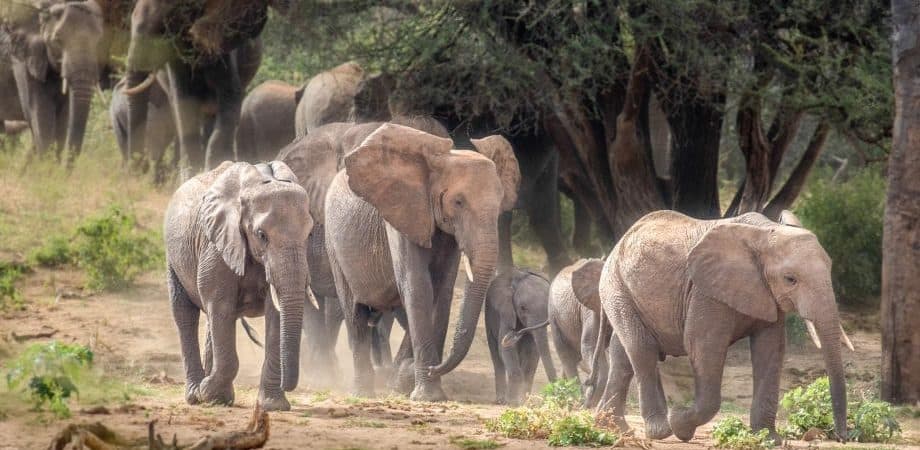
Lion are present, though densities are lower than in the Mara or Amboseli. Cheetah occur in the more open sections. African wild dog are occasionally recorded; their presence in the Samburu ecosystem is irregular but documented. Elephant are common and use the river extensively.
Birdlife is rich and includes several northern Kenya specialties. Vulturine guineafowl, golden-breasted starling, Somali bee-eater, Basra reed warbler, and various dry-country hornbills are among the distinctive species. Over 450 species are recorded across the Samburu-Buffalo Springs-Shaba complex.
On the Ground
Safari Experiences
Game drives along the Ewaso Ng'iro River and into the interior scrub are the primary activity. Morning drives (06:00 departure) are the most productive, both for temperature and for predator activity. Afternoon drives (15:30 to 18:00) cover the late movement toward the river. Midday breaks are standard given the heat.
Night drives from camp are productive for leopard and various nocturnal species. Cats and smaller predators are active along the riverine corridor.
Walking safaris with rangers are available from some camps. The dry country terrain is suitable for walking, though the heat and thorny vegetation require appropriate footwear and timing.
Cultural encounters with Samburu communities adjacent to the reserve are available from most lodges. The Samburu people and their close relatives the Maasai share many cultural elements, but the Samburu have maintained a more isolated and distinct identity. Community visits are genuinely informative when guided well.
Boat trips are not available; the Ewaso Ng'iro River is not navigable in this section.
Regions of the Park
Ewaso Ng'iro River Corridor: The most productive zone and the one most drives focus on. Leopard, lion, elephant, and crocodile all concentrate along this strip. Most lodges are positioned in or adjacent to this zone.
Interior Acacia Scrub: The dry country wildlife zone. Grevy's zebra, gerenuk, oryx, and Somali ostrich tend to be found here rather than at the river. Morning drives that swing into the interior typically provide the best Special Five opportunities.
Koitogor Inselberg Area: The rocky inselberg and its surrounds are productive leopard habitat and provide a landscape feature in an otherwise flat terrain.
Buffalo Springs (Across the River): The reserve directly south of the Ewaso Ng'iro is administered separately but accessed from the same entry points. The springs themselves attract elephant and provide a good wildlife focal point on the southern side.
Planning Your Visit
Best Time to Visit
June to October is the dry season and the recommended period. The Ewaso Ng'iro River level drops and wildlife concentrates more predictably along its banks. Dust levels increase but visibility through the low vegetation is good.
January to February is the short dry season and a reliable secondary window. The landscape retains some green from the November rains, which can improve photography conditions.
November: Short rains begin and bird activity peaks. The reserve remains accessible but some interior tracks become muddy. A good time for birding.
Getting There
By charter flight: Wilson Airport in Nairobi to Samburu Airstrip takes approximately 1 hour. This is the practical and recommended approach for most travelers. Charter flights are arranged through your operator and typically include a lodge transfer.
By road: The drive from Nairobi to Samburu takes approximately 5 to 6 hours via Nanyuki. The road is good until the final section. A 4WD is recommended. Road access works for travelers combining Samburu with Laikipia or Ol Pejeta Conservancy on a northern Kenya circuit.
How Many Nights
2 nights gives two full days and is adequate for the primary Special Five species and a leopard encounter. The reserve is small enough to cover its main zones in this time.
3 nights allows for a more relaxed pace, the cultural visit, night drives, and more time for specific species that may require patience (wild dog, cheetah).
Samburu is typically combined with other northern Kenya destinations on a circuit. Ol Pejeta or Laikipia to the south, or the Mathews Range to the north for more adventurous itineraries.
Where to Stay
Luxury Lodges and Camps
Saruni Samburu: A luxury camp in a private conservancy adjacent to the reserve with individual villa-style rooms in the rocky hillside above the valley. Strong guiding, very limited guest numbers, and access to the private conservancy land as well as the reserve. One of the most consistently recommended properties in northern Kenya.
Elephant Bedroom Camp: A tented camp on the Ewaso Ng'iro River with a strong elephant focus and a well-positioned location for river drives. More accessible in pricing than Saruni but at a high standard.
Sasaab: A Moroccan-inspired lodge above the Ewaso Ng'iro River with bold design and community conservancy access. A distinctive property that suits travelers who respond to character as much as conventional safari standards.
Midrange Lodges and Camps
Samburu Intrepids: A Midrange camp with a good riverside position and reliable access to the reserve. Consistent standards and suitable for travelers who want solid guiding and facilities without Luxury pricing.
Zorani uses its current Luxury and Midrange accommodation tiers in Samburu. Midrange selection should be based on verified room standards, location, game-drive access, and current operating status.
Combining With Other Destinations
Ol Pejeta Conservancy is the most natural southern companion to Samburu. Ol Pejeta is approximately 2 hours south via Nanyuki and offers the northern white rhino, black rhino, Big Five, and a complementary wildlife experience. Many travelers fly into Samburu, then drive or fly south to Ol Pejeta before continuing to the Mara.
Laikipia Plateau: Multiple private conservancies on the Laikipia Plateau sit between Samburu and Nairobi. The plateau offers a very different conservation model (private land, diverse activities, walking and riding safaris) that pairs well with the Samburu reserve experience.
Masai Mara: Charter connections from Samburu to the Mara take approximately 1 to 1.5 hours. Northern Kenya (Samburu and Laikipia) combined with the Mara in the south is a Kenya circuit that covers the country's most contrasting ecosystems.
Photography
Samburu's combination of species, open terrain, and reliable leopard makes it one of Kenya's strongest photographic destinations. Reticulated giraffe against the rocky hillside backdrop, gerenuk in characteristic upright feeding posture, and Grevy's zebra in the dry scrub all provide subjects that the southern parks cannot offer.
The Ewaso Ng'iro River provides a reflective surface and a backdrop of doum palms that frames elephant and crocodile shots in a way that is genuinely distinctive. The leopard sightings in the riverine vegetation, often at close range due to habituation, are among the most sought-after cat encounters in Kenya.
Light in the reserve is strong and direct given the low latitude. Early morning (06:00 to 09:00) and late afternoon (16:30 to 18:30) provide the best conditions. Midday work in the riverine shade can still be productive.
Samburu Questions
What are the Samburu Special Five?
The five dry-country species found in Samburu and northern Kenya but absent from the main southern parks: reticulated giraffe, Grevy's zebra, gerenuk, Beisa oryx, and Somali ostrich. Each is ecologically adapted to the semi-arid environment north of the equator and makes Samburu a genuinely distinct destination from the Masai Mara or Amboseli.
Are the Samburu Special Five guaranteed on a visit?
Reticulated giraffe, Grevy's zebra, and gerenuk are encountered on the majority of days in the reserve. Beisa oryx and Somali ostrich are present but require drives into the interior scrub. A focused effort over two nights should produce most of the five. The reserve is small enough that a good guide can cover the relevant habitats efficiently.
Is Samburu worth visiting if I am also going to the Masai Mara?
Yes. The Mara and Samburu are complementary rather than redundant. The Mara is about predator density, Great Migration scale, and the southern grassland ecosystem. Samburu is about dry-country species, exceptional leopard encounters, and a fundamentally different northern Kenya environment. Together they produce one of the strongest Kenya circuits available.
How does the leopard sighting rate compare to other parks?
Samburu consistently produces high leopard sighting rates, largely due to the relatively small reserve size, the concentrated riverine habitat along the Ewaso Ng'iro River, and the habituation of individual leopards to vehicles. It is arguably the most reliable single destination for leopard in Kenya.
Is Samburu a national park or a reserve?
A national reserve, administered by the County Council rather than the Kenya Wildlife Service. This distinction affects revenue distribution but has no practical impact on the visitor experience. The adjacent Buffalo Springs National Reserve lies across the Ewaso river to the south and Shaba National Reserve further east; all three form part of the same ecosystem.
What is the Ewaso Ng'iro River?
A permanent river that rises in the Aberdares and flows eastward through Samburu before eventually losing itself in the Lorian Swamp. It is the permanent water source that makes the Samburu reserves viable in an otherwise very arid landscape. The riverine woodland fringing the banks is the most productive zone for predator and leopard sightings.
When is the best time to visit Samburu?
June to October is the primary dry season recommendation, when wildlife concentrates along the Ewaso Ng'iro and game viewing is most productive. January to February is also good. Samburu receives less rainfall than southern parks and is visitable in most months, but the short rains (November) can make tracks difficult. The heat is significant year-round; early morning drives are essential.
How do I get to Samburu?
Samburu is approximately 350 kilometres north of Nairobi, a 5 to 6 hour drive or a 50 minute charter flight to Samburu airstrip from Wilson Airport. Charter is the standard approach for most itineraries. The road route via Isiolo and Archer's Post is the main land access.
What accommodation is available at Samburu?
Samburu has a well-developed accommodation offer given its relatively small size. Sasaab, Elephant Bedroom, Saruni Samburu, and Samburu Intrepids are among the established camps. Most are riverine in position, providing direct access to the most productive wildlife corridor. Accommodation quality is high by northern Kenya standards.
What makes Samburu different from the Masai Mara in practical terms?
The Mara is larger, busier, and more focused on grassland predators and the Great Migration. Samburu is smaller, quieter, hotter, and structured around the river corridor. The dry-country species list is entirely different. Vehicle concentrations at popular sightings are much lower in Samburu. The two parks are best understood as covering completely different ecosystems rather than competing versions of the same experience.
Zorani Expeditions
Plan Your Samburu Safari
Every Journey we design is built around your goals, not a standard route.
Speak to a Specialist