
UGANDA · EAST AFRICA
Rwenzori
The snow-capped equatorial range Ptolemy mapped as the source of the Nile
Overview
The Mountains of the Moon
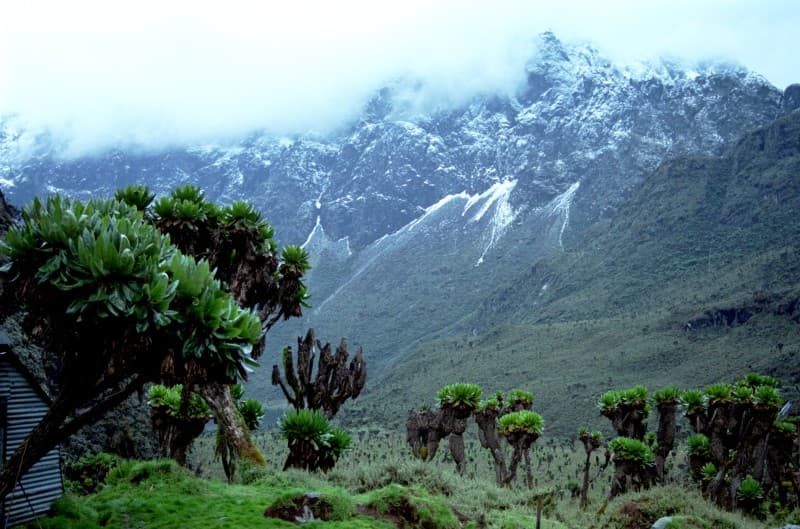
The Rwenzori Mountains rise from western Uganda along the DRC border as a series of high, permanently glaciated peaks. The range is not volcanic. It is an ancient block of crystalline rock uplifted through rifting, and its age and geology have given rise to a suite of extraordinary vegetation zones found nowhere else on Earth at altitude. Giant lobelias, enormous tree groundsels, heather covered in moss and lichen, and saturated boggy terrain create a landscape that travelers and explorers have consistently described as surreal.
Margherita Peak, on Mount Stanley at 5,109 metres, is the third highest point in Africa and the highest point in Uganda. Trekking the Rwenzori Central Circuit, which traverses the main peaks and valleys over 7 to 9 days, is one of the most demanding and most distinctive trekking experiences on the continent. It is not a wildlife destination in the conventional safari sense, though chimpanzee, colobus monkey, and various Albertine Rift endemic birds are found in the lower forest zones.
The park was designated a UNESCO World Heritage Site in 1994. It sits in the Kasese area of western Uganda, accessible by charter flight or road from Kampala.
Environment
Primordial Landscapes
The Rwenzori range runs approximately 120km north to south along the Uganda-DRC border. Six major massifs make up the high peaks: Mount Stanley (5,109m, Margherita Peak), Mount Speke (4,890m), Mount Baker (4,843m), Mount Emin (4,798m), Mount Gessi (4,715m), and Mount Luigi di Savoia (4,627m). The mountains are permanently snow-capped on the highest ridges, though the glaciers have retreated significantly over the past century.
The vegetation zones, which shift with altitude, are a primary feature of the Rwenzori. Montane rainforest occupies the lower slopes from around 1,800m to 2,500m. Above this, bamboo gives way to a zone of giant heather and Podocarpus. From approximately 3,500m to 4,000m, the landscape transitions into the characteristic Rwenzori afro-alpine zone: giant groundsels, giant lobelias, everlasting flowers, and deep, boggy valleys. Above 4,500m the terrain becomes rocky moorland, glacial moraine, and permanent snow and ice.
The Rwenzori receives high rainfall year-round due to its position at the edge of the Congo Basin. The boggy, waterlogged character of the middle and upper zones is a constant feature. Routes are fitted with boardwalks and log bridges in key sections, but the conditions are consistently wet.


The Trek
The Central Circuit
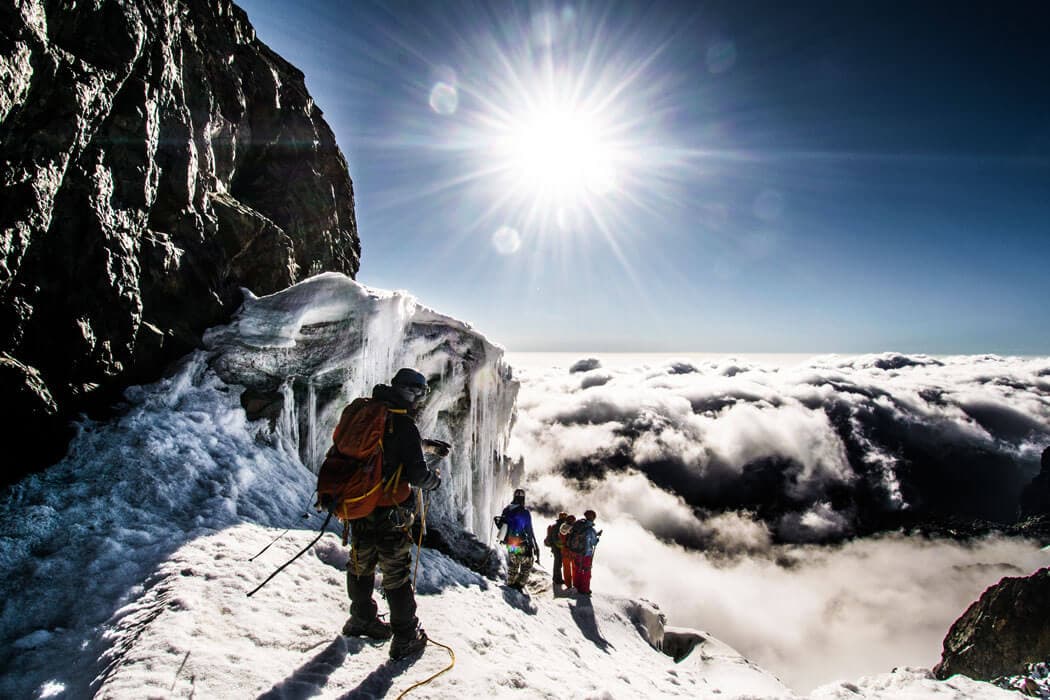
The Central Circuit is the primary trek and the experience most travelers come for. The route covers approximately 55km over 7 to 9 days, ascending through all vegetation zones to the high peaks and returning via a different valley. Summit attempts on Margherita Peak require an additional day, technical rope work, and are typically offered as an add-on to the circuit. The peak is only for experienced alpinists with acclimatisation time built in.
Shorter lower-slope trails are available for travelers who want a Rwenzori experience without committing to the full circuit. The Mahoma Trail (2 to 3 days) penetrates the lower forest and heather zones, providing good birding and an introduction to the mountain environment without the altitude exposure and full demands of the Central Circuit.
Day walks from Kasese or the park base at Mihunga are possible for travelers with limited time who want a taste of the montane forest environment.
Birding on lower slopes is a specialist option for Albertine Rift birders. The lower trails can be walked with a guide in a single morning and cover key endemic species in a compressed timeframe.
All trekking requires UWA permits and is conducted with registered guides and porters. Porters carry equipment and play an important role in the logistics of multi-day treks; the porter system is central to the Rwenzori trekking economy and is well organised.
Best Time
December to February is one of the two dry season windows. This is the recommended period for the full circuit, offering the most stable conditions on the mountain. Trails are less waterlogged and the views from higher zones are clearer.
June to August is the other reliable dry window and coincides with the peak Uganda travel season. A good time to plan the circuit.
March to May (long rains): The mountain is climbable but conditions are very wet. The boggy zones become more challenging, visibility is reduced, and the physical demands increase significantly. Experienced trekkers who want solitude sometimes visit in this period but it is not recommended for those doing the circuit for the first time.
September to November: Short rains arrive from October. Early September can be reasonable, but the risk of wet conditions increases. The main circuit is possible but less reliable than the two dry season windows.
It is worth noting that even in the dry seasons, the Rwenzori receives regular precipitation and conditions can change rapidly at altitude. No month guarantees dry weather on the mountain; the dry seasons simply reduce the probability of sustained heavy rain.
Getting There
By charter flight: Kasese Airstrip is the closest commercial airstrip to the Rwenzori. Charter flights from Entebbe or Kajjansi take approximately 45 to 60 minutes. The transfer from Kasese to the park gate at Mihunga is approximately 30 to 40 minutes by road.
By road from Kampala: The drive from Kampala to Kasese takes approximately 5 to 6 hours along the Fort Portal road. This is a practical option for travelers who are already in western Uganda on a broader circuit.
From Fort Portal: Kasese is approximately 1 hour from Fort Portal by road. Travelers combining the Rwenzori with Kibale Forest or Semuliki can drive directly from Fort Portal.
Duration
The Central Circuit: 7 to 9 days is the standard range. A 7-day circuit covers the main valleys and zones at a demanding pace. 8 to 9 days allows for acclimatisation, a rest day, and better summit weather windows. The circuit should not be rushed; altitude-related symptoms are a genuine risk if the ascent profile is too aggressive.
Margherita Peak add-on: An additional 1 to 2 days on top of the circuit for the summit attempt. This requires prior trekking experience and physical preparation. The summit involves glacier travel and rope techniques; this is not a scramble for the unprepared.
Short treks: 2 to 3 days for the Mahoma Trail or lower-slope alternative routes. This works for travelers who want an experience of the mountain environment without the full commitment.
Accommodation & Logistics
Trekking Huts
The Central Circuit Hut System consists of a series of mountain huts spaced along the route at intervals suited to daily walking stages. Huts are basic but shelter-adequate: sleeping platforms, mattresses, toilet facilities. They are not comfortable lodges. Night temperatures at the higher huts can drop significantly below zero. Sleeping bags rated to at least -10°C are required.
Rwenzori Mountaineering Services (RMS) manages the hut system and the official guide and porter service. Bookings for the circuit are made through RMS or through an operator like Zorani.
Base Camp and Lower Accommodation
Rwenzori Trekking Services Basecamp (Mihunga): The functional base for most circuit departures. Accommodation is simple and the focus is on preparation and departure logistics. A practical overnight before an early start.
Sandton Hotel (Kasese): For travelers arriving into Kasese and spending a night before the trek, the Sandton is the standard option in town. Facilities are adequate for a transit night.

Combining the Rwenzori
Kibale National Park pairs naturally with the Rwenzori. Both are in the Fort Portal area, roughly 1 to 1.5 hours apart. A combined itinerary of chimpanzee trekking at Kibale and the Rwenzori lower circuit or full Central Circuit is a compelling western Uganda program.
Queen Elizabeth National Park is approximately 2 hours south of Kasese. Many travelers include QENP as a savannah counterpart to the mountain trekking, completing a western circuit that covers very different terrain types.
Semuliki National Park is accessible west of Fort Portal and adds the Congo Basin birding component to a western Uganda circuit.
Stand-alone Rwenzori journey: The full Central Circuit can be approached as a dedicated trekking trip from Entebbe, without combining it with safari parks. This suits travelers whose primary interest is mountain trekking.
Rwenzori Mountains FAQ
How difficult is trekking in the Rwenzori Mountains?
Challenging to very challenging. The Rwenzori is considered one of the most demanding mountain treks in Africa. The terrain is steep, the ground is almost permanently boggy above the montane forest zone, and the upper slopes require scrambling and, on the highest routes, basic technical glacier skills. Altitude is an additional factor: Margherita Peak on Mount Stanley reaches 5,109 m, making it the third-highest point in Africa. Strong fitness, prior mountain experience, and proper acclimatisation are required. This is not a casual hike.
How long does the standard Rwenzori circuit take?
The standard Rwenzori Central Circuit takes 7 to 9 days, typically summiting Weismann's Peak (4,620 m) and traversing through the major valleys. The full summit route to Margherita Peak on Mount Stanley is more technical and adds at least 2 days. All treks are guided by Rwenzori Mountaineering Services (RMS), the park-authorised operator, and are fully catered with porters. There is no solo trekking permitted. Shorter 3 to 5 day lower-altitude options exist for visitors wanting the vegetation and scenery without the full circuit.
Is there really snow on the Rwenzori?
Yes. The Rwenzori is one of only three equatorial mountain massifs in Africa with permanent snow and glaciers (alongside Kilimanjaro and Mount Kenya). The glaciers are receding rapidly due to climate change (significantly smaller than when mapped in the 20th century) but they remain. Standing on a glacier within half a degree of the equator, looking out over the Congo basin, is among the most surreal experiences in African travel.
What are the unique vegetation zones of the Rwenzori?
The Rwenzori has some of the most distinctive montane vegetation on earth, organised in clear altitudinal bands. The lower slopes are montane rainforest with tree ferns and rich birdlife. Above 2,500 m, the bamboo zone gives way to the extraordinary Afroalpine zone: giant heather trees draped in moss, giant groundsels (Senecio adnivalis) reaching 6 metres, giant lobelias (Lobelia wollastonii), and tussock grass bogs. This alien landscape (often shrouded in mist) is the reason serious mountain trekkers rank the Rwenzori alongside Kilimanjaro for botanical interest, and ahead of it for strangeness.
What is the best time to trek the Rwenzori?
December to February and June to August are the drier windows and the recommended trekking seasons. The Rwenzori is notoriously wet: it receives some of the highest rainfall in Uganda year-round because the massif forces moisture-laden air upward. Even in the dry seasons, rain and mist are common above 3,000 m. The wettest months (March to May and September to November) make trail conditions difficult and summit visibility poor. Most operators will not schedule Rwenzori treks outside the dry windows.
What accommodation is available on the mountain?
A series of basic mountain huts operated by Rwenzori Mountaineering Services (RMS) are located at each night's stopping point on the circuit. The huts are simple structures with sleeping platforms and mattresses, communal dining areas, and basic toilet facilities. They are not luxurious but are dry and functional. All food, cooking equipment, and supplies are carried by porters. Sleeping bags and warm layering are essential and should be brought by trekkers; a gear list is provided at booking.
Is the Rwenzori worth it compared to Kilimanjaro?
They are very different mountains. Kilimanjaro is higher (5,895 m vs 5,109 m for Margherita Peak), more accessible, has a larger operator network, and is achievable by non-technical trekkers on the main routes. The Rwenzori is wetter, more technically demanding, more remote, and far less visited: making it the better choice for experienced mountain trekkers who want genuine wilderness rather than a managed experience. The Afroalpine vegetation is more extraordinary than anything on Kilimanjaro. For first-time African high-altitude trekking, Kilimanjaro is the better starting point; for those seeking something harder and stranger, the Rwenzori.
What permits and guides are required for the Rwenzori?
All trekkers must enter through the National Park via the Nyakalengija trailhead and be accompanied by licensed guides and porters from Rwenzori Mountaineering Services (RMS), the park-authorised operator. Independent trekking is not permitted. Park entry fees are paid to Uganda Wildlife Authority; guide and porter fees are paid through RMS. Total costs for the 7-day circuit including all fees, accommodation, guide, and cook typically run USD 800 to USD 1,200 per person depending on group size. Your operator handles all of this: Rwenzori is not a self-arrange trek.

Plan Your Trek
Speak to a specialist to discuss route options, acclimatisation, and how to fit the Rwenzori into a broader Uganda journey.
Speak to a Specialist