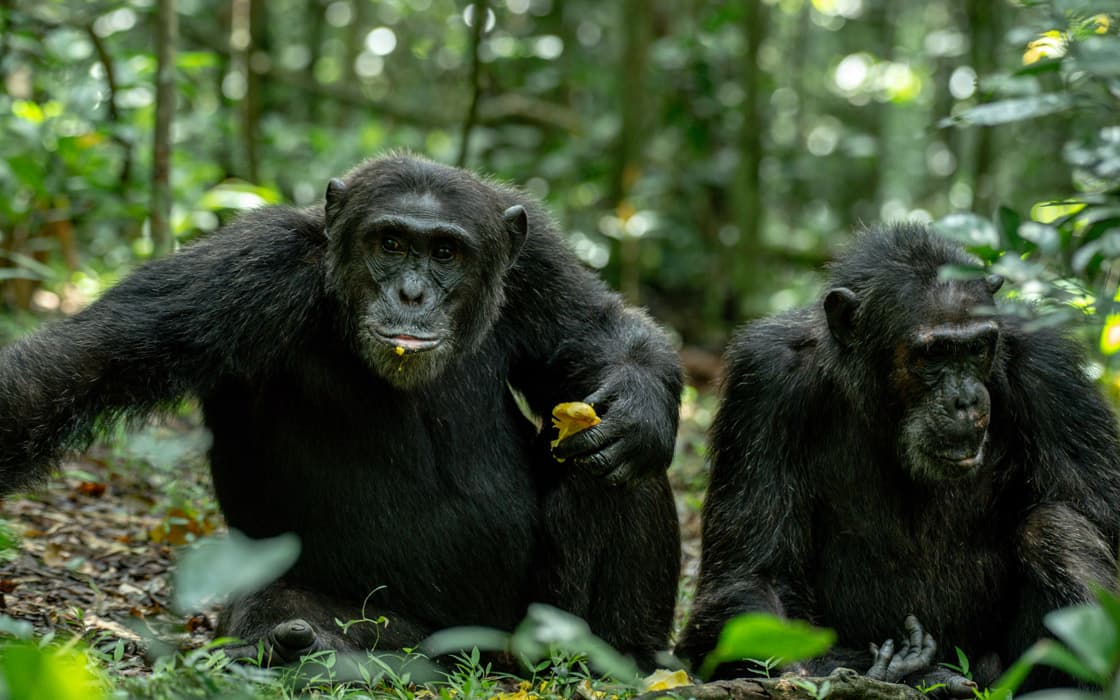
Most visitors to Kibale Forest National Park spend an hour with wild chimpanzees before returning to their lodge.
The Chimpanzee Habituation Experience is different.
Instead of joining a standard morning trek, you spend most of the day alongside the researchers and trackers who are gradually introducing a chimpanzee community to human presence. You'll leave camp before sunrise, follow the group as they wake, feed and travel through the forest, and stay until they begin settling for the evening.
It isn't simply a longer chimp trek. It's a closer look at how wildlife conservation actually works.
What Is the Chimpanzee Habituation Experience?
Chimpanzee habituation is the process of helping wild chimpanzees become accustomed to the presence of researchers and visitors without changing their natural behaviour.
The process takes years.
Researchers spend thousands of hours following the same community, allowing the chimpanzees to slowly accept people as a normal part of their environment. Only once that process is complete can a group become available for regular tourism.
The habituation experience allows visitors to observe part of that process while it is still happening.
How Is It Different From a Standard Chimpanzee Trek?
The biggest difference is time.
Standard Trek Habituation Experience Around 1 hour with chimpanzees Up to 4 hours with chimpanzees, within a full-day forest experience Fully habituated community Community still undergoing habituationTourist-focusedResearch and conservation focused Shorter forest walk Longer, more demanding day.
The atmosphere also feels different.
On a standard trek, the objective is finding the chimpanzees and enjoying the hour you're allowed to spend with them.
During habituation, there is less urgency.
You follow the researchers' pace, watch how they interpret behaviour and gain a better understanding of chimpanzee social life rather than simply observing it.
What Happens During the Day?
The day begins early, often before sunrise.
After a briefing from Uganda Wildlife Authority guides and researchers, you head into Kibale Forest while the chimpanzees are still in their overnight nests.
Every day unfolds differently, but you may witness:
Morning calls echoing through the forest canopy
Feeding behaviour
Grooming between family members
Mothers carrying young infants
Territorial displays
Nest building later in the day
Because the chimpanzees remain semi-habituated, they often behave more naturally than groups accustomed to daily tourism.
Some days they remain close for long periods.
On others, you'll spend much of the day following them through the forest.
That uncertainty is part of the experience.
Is It Physically Demanding?
Yes.
Expect a full day of walking through uneven forest terrain, with frequent changes in pace depending on how the chimpanzees move.
Conditions vary throughout the year.
After rain, sections of the forest can become muddy and slippery. During drier months, walking is generally easier, although humidity remains high beneath the canopy.
Reasonable fitness is recommended, but you don't need to be an experienced hiker.
Why Does Habituation Matter?
Tourism is only one outcome of habituation.
The work primarily supports long-term conservation and scientific research.
Researchers use these years to understand:
Family relationships
Feeding patterns
Health
Population dynamics
Territory use
Behavioural changes over time
Permit revenue also contributes towards protecting Kibale Forest, supporting ranger patrols and creating employment for communities living around the park.
Without that investment, long-term chimpanzee research would be far more difficult to sustain.
Is It Worth Choosing Over a Standard Trek?
That depends on what you're looking for.
If your goal is simply to see wild chimpanzees during a broader safari, the standard trek is an excellent experience.
The habituation programme suits travellers who want more context.
Wildlife photographers appreciate the additional time.
Conservation-minded travellers gain a better understanding of the work happening behind the scenes.
Anyone fascinated by animal behaviour usually finds the extra hours far more rewarding than another game drive.
Best Time to Visit
Chimpanzee habituation runs throughout the year.
The drier months, from June to August and December to February, generally provide easier walking conditions.
The wetter seasons often bring greener forests, fewer visitors and excellent photography, although trails can become considerably more challenging.
There is no bad season.
The forest simply changes character.
Practical Information
Location: Kibale Forest National Park
Duration: Full day
Minimum Age: 15
Permit: Required and subject to daily availability.
Because only a limited number of visitors take part each day, permits should be secured well before travel, particularly during the busiest months.
Frequently Asked Questions
Can I combine chimpanzee habituation with gorilla trekking?
Yes.
Many travellers combine Kibale with Bwindi Impenetrable National Park as part of a longer primate-focused journey.
Is the experience suitable for photographers?
Yes.
The longer observation period provides more opportunities to photograph different behaviours and changing forest light than a standard one-hour trek.
Will I definitely spend the full day with chimpanzees?
Not necessarily.
The experience follows wild animals moving through a natural forest. Some time is spent tracking, walking and observing from different distances rather than continuously watching the chimpanzees.
That unpredictability is exactly what makes the experience authentic.
If your interest extends beyond simply seeing chimpanzees, Kibale's habituation programme offers one of the most immersive wildlife experiences in Africa. Instead of watching conservation from the outside, you spend a day alongside the people doing the work, gaining a much deeper understanding of both the forest and the animals that depend on it.